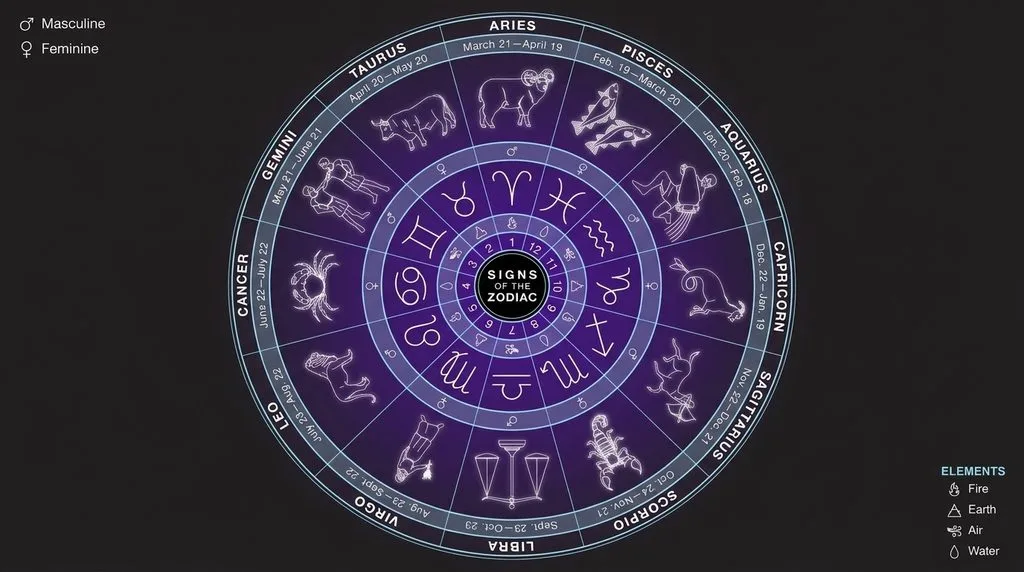

TL;DR: Your zodiac sign (also called your sun sign or star sign) is set by the position of the Sun on your birthday. There are 12 signs, each spans about 30 days, and most calendar months contain pieces of two signs. If you were born on a cusp (the 1–2 day border between signs), you need your birth year and birth time to know for sure — the dates shift by about a day from year to year. No, NASA did not add a 13th sign, and no, your sign didn’t change.
What your birthday actually tells the sky
Every time someone asks “what’s your sign?”, they’re asking about your sun sign — the slice of the zodiac the Sun was moving through the moment you were born. It’s the most popular entry point into astrology, and for good reason: it’s simple, it’s tied to your birthday, and it gives you a quick shorthand for your core personality.
Astrology is having a real moment. A Pew Research Center survey of 9,593 U.S. adults in October 2024 found that 27% of Americans believe in astrology, and 28% check their horoscope at least once or twice a year. Among adults under 30, that number climbs even higher. Whether you read it for fun, for self-reflection, or because you genuinely think the stars nudge your personality, it all starts with the same question: which sign does my birthday fall under?
This guide gives you the full picture — exact dates, every month’s two signs, the elements and modalities, what to do if you were born on a cusp, and the truth behind the “13th sign” panic that keeps going viral.
The 12 zodiac signs and dates at a glance
Here’s the master table. These are the standard tropical zodiac dates used by nearly every Western horoscope column, app, and astrologer. The exact changeover can move a day either way depending on the year, so if your birthday lands on a border, check the cusp section below.
| Sign | Symbol | Dates | Element | Modality | Ruler | One-line vibe |
|---|---|---|---|---|---|---|
| ♈ Aries | Ram | Mar 21 – Apr 19 | Fire | Cardinal | Mars | Leaps first, thinks later |
| ♉ Taurus | Bull | Apr 20 – May 20 | Earth | Fixed | Venus | Slow, steady, loves comfort |
| ♊ Gemini | Twins | May 21 – Jun 20 | Air | Mutable | Mercury | Curious, chatty, easily bored |
| ♋ Cancer | Crab | Jun 21 – Jul 22 | Water | Cardinal | Moon | Nurturing, loyal, a little moody |
| ♌ Leo | Lion | Jul 23 – Aug 22 | Fire | Fixed | Sun | Born for the spotlight |
| ♍ Virgo | Maiden | Aug 23 – Sep 22 | Earth | Mutable | Mercury | Analytical, helpful, perfectionist |
| ♎ Libra | Scales | Sep 23 – Oct 22 | Air | Cardinal | Venus | Charming, fair, hates conflict |
| ♏ Scorpio | Scorpion | Oct 23 – Nov 21 | Water | Fixed | Pluto/Mars | Intense, secretive, all-in |
| ♐ Sagittarius | Archer | Nov 22 – Dec 21 | Fire | Mutable | Jupiter | Adventurous, blunt, restless |
| ♑ Capricorn | Sea Goat | Dec 22 – Jan 19 | Earth | Cardinal | Saturn | Ambitious, disciplined, climbs |
| ♒ Aquarius | Water Bearer | Jan 20 – Feb 18 | Air | Fixed | Uranus/Saturn | Independent, quirky, humanitarian |
| ♓ Pisces | Fish | Feb 19 – Mar 20 | Water | Mutable | Neptune/Jupiter | Dreamy, empathic, artistic |
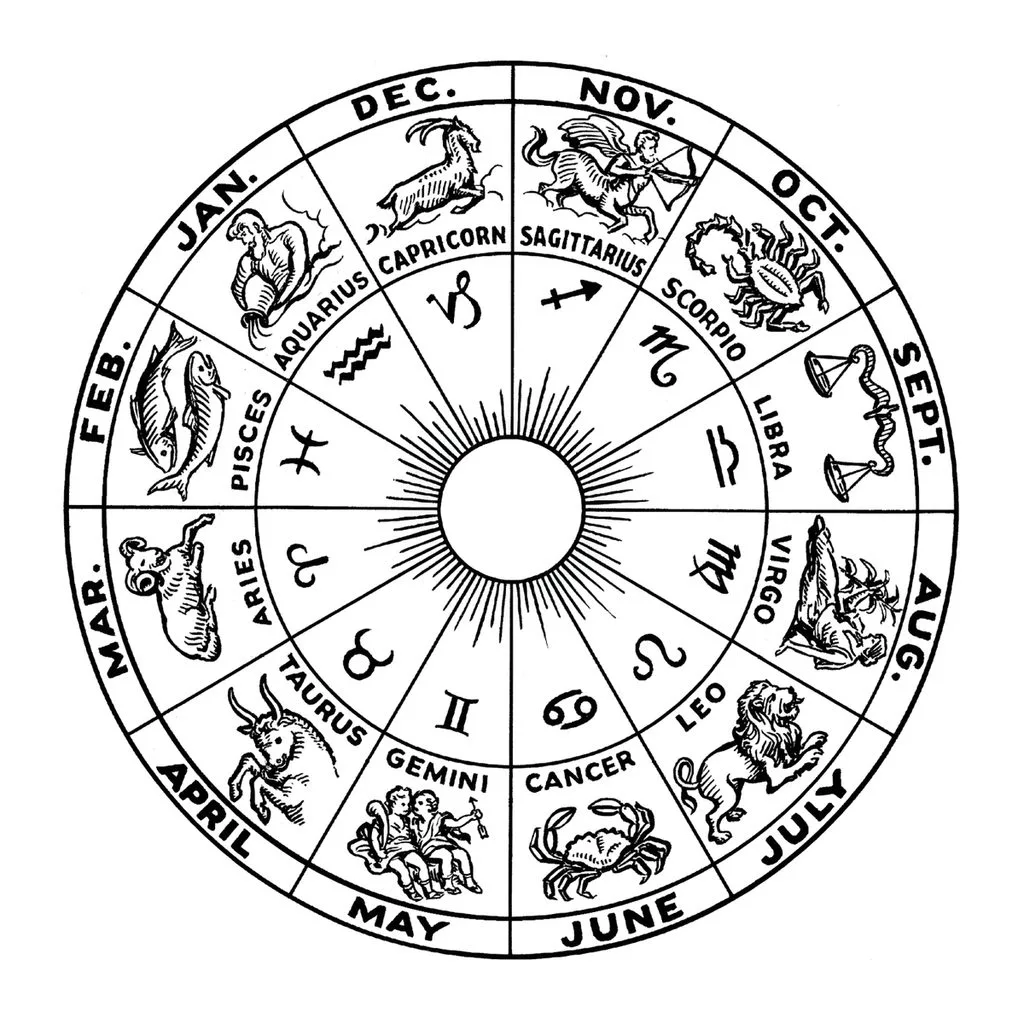
Zodiac signs by month: which birthday signs share each month
This is the part that trips almost everyone up. No calendar month maps cleanly to one sign. The zodiac starts on the spring equinox (around March 20–21), not on January 1, so every month straddles a sign boundary. Here’s exactly what you get in each month.
January: Capricorn + Aquarius
- Jan 1–19: Capricorn — disciplined, goal-driven, quietly ambitious.
- Jan 20–31: Aquarius — the independent thinker who loves a good cause.
February: Aquarius + Pisces
- Feb 1–18: Aquarius — quirky, future-focused, marches to their own beat.
- Feb 19–28/29: Pisces — the dreamy empath who feels everything.
March: Pisces + Aries
- Mar 1–20: Pisces — creative, compassionate, often lost in thought.
- Mar 21–31: Aries — the zodiac’s spark plug, kicking off a brand new cycle.
April: Aries + Taurus
- Apr 1–19: Aries — bold, competitive, hates waiting.
- Apr 20–30: Taurus — slows everything down and enjoys the view.
May: Taurus + Gemini
- May 1–20: Taurus — sensual, reliable, stubborn in the best way.
- May 21–31: Gemini — talkative, curious, already onto the next topic.
June: Gemini + Cancer
- Jun 1–20: Gemini — witty, versatile, needs mental stimulation.
- Jun 21–30: Cancer — the caretaker who remembers everyone’s birthday.
July: Cancer + Leo
- Jul 1–22: Cancer — protective, sentimental, runs on emotion.
- Jul 23–31: Leo — warm, generous, and very okay with being the center of attention.
August: Leo + Virgo
- Aug 1–22: Leo — creative, loyal, dramatic in the most fun way.
- Aug 23–31: Virgo — sharp, organized, quietly fixing everyone’s problems.
September: Virgo + Libra
- Sep 1–22: Virgo — practical, detail-obsessed, always improving something.
- Sep 23–30: Libra — diplomatic, charming, obsessed with fairness.
October: Libra + Scorpio
- Oct 1–22: Libra — sociable, romantic, hates choosing sides.
- Oct 23–31: Scorpio — intense, magnetic, sees right through you.
November: Scorpio + Sagittarius
- Nov 1–21: Scorpio — passionate, private, all or nothing.
- Nov 22–30: Sagittarius — the adventurer who’s already planning the next trip.
December: Sagittarius + Capricorn
- Dec 1–21: Sagittarius — optimistic, honest, sometimes too honest.
- Dec 22–31: Capricorn — responsible, driven, already mapping next year’s goals.
How the zodiac calendar actually works
The word “zodiac” comes from the Greek zōdiakos kyklos, meaning “circle of little animals.” The Babylonians divided the sky’s ecliptic (the apparent path of the Sun) into 12 equal 30° slices around 500 BCE, and most of the names and symbols they used are still with us today. You can dig into the full history in Britannica’s zodiac overview, which also covers why the system spread through Greek and then Islamic and European culture.
Two things make the dates feel fuzzy:
- It starts on the equinox, not New Year’s Day. Aries begins at the March (vernal) equinox, which falls on March 19, 20, or 21 depending on the year. Because every sign is exactly 30° long, every subsequent sign starts roughly 30 days later — and that pushes each boundary a day forward or backward depending on leap years.
- Tropical vs. sidereal. Western astrology uses the tropical zodiac, which is anchored to the seasons (equinoxes and solstices), not to the actual star patterns. Vedic (Indian) astrology uses the sidereal zodiac, which is anchored to the constellations themselves — so your Vedic sign is often one sign earlier than your Western sign. Both are internally consistent; they just measure from different starting lines. The distinction is explained clearly in this tropical vs. sidereal breakdown.
This is why you’ll see slightly different dates across websites. A site that says Taurus starts April 19 and another that says April 20 are both basically right — it depends on the year.
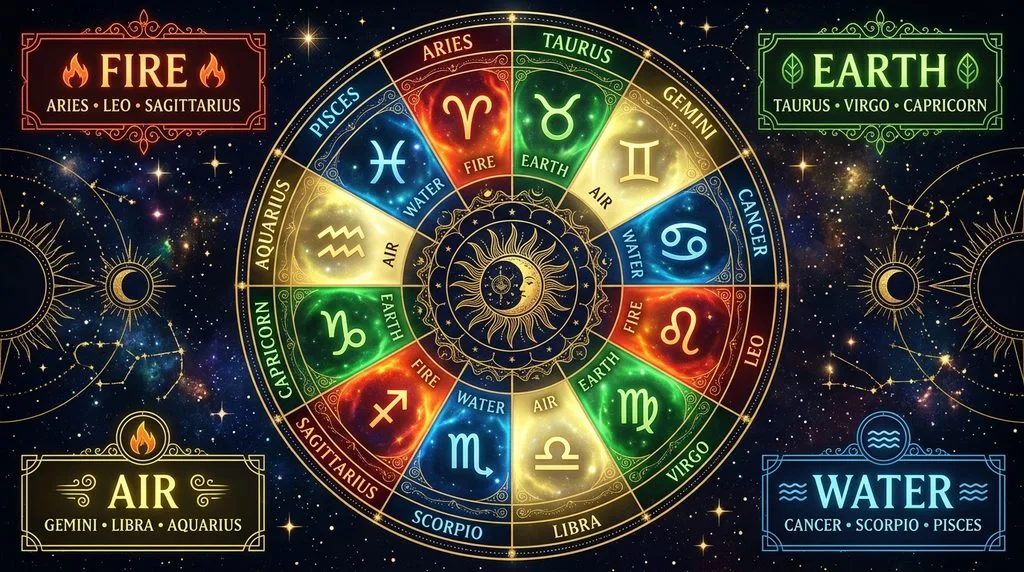
The four elements: why signs of the same element feel like family
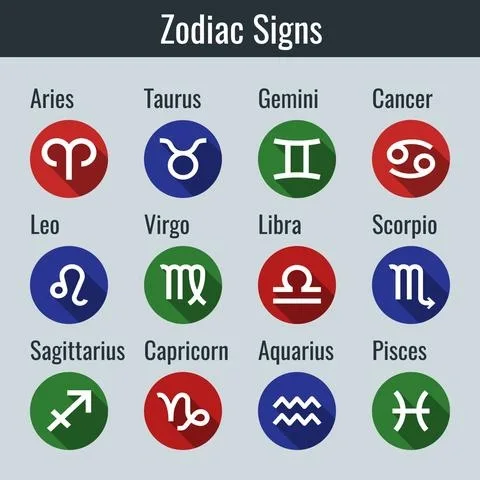
Every sign belongs to one of four elements, and this is the fastest way to understand a sign’s energy. Signs of the same element tend to understand each other instantly.
- Fire (Aries, Leo, Sagittarius): Passionate, action-oriented, warm. They do things first and course-correct later. They inspire everyone around them and burn out if they don’t rest.
- Earth (Taurus, Virgo, Capricorn): Practical, grounded, reliable. They build things that last and care about tangible results. They can get stuck in routine.
- Air (Gemini, Libra, Aquarius): Intellectual, social, communicative. They live in the world of ideas and connections. They can overthink and under-feel.
- Water (Cancer, Scorpio, Pisces): Intuitive, emotional, empathic. They feel deeply and often pick up on vibes others miss. They can get overwhelmed by their own sensitivity.
The three modalities: how each sign takes action
Modality (or quality) describes how a sign moves through the world, and it lines up with where the sign falls in its season. There are three modalities, four signs each.
- Cardinal (Aries, Cancer, Libra, Capricorn): These signs start the seasons — spring, summer, fall, winter. They’re initiators. They love to launch things, and they sometimes struggle to finish them.
- Fixed (Taurus, Leo, Scorpio, Aquarius): These signs hold the middle of a season. They’re sustainers — steady, consistent, stubborn, great at seeing a project through.
- Mutable (Gemini, Virgo, Sagittarius, Pisces): These signs end a season and bridge into the next. They’re adapters — flexible, versatile, comfortable with change, sometimes scattered.
Combine element + modality and you get a surprisingly sharp thumbnail sketch. A Cardinal Water sign (Cancer) initiates through emotion and caretaking. A Fixed Earth sign (Taurus) sustains through stubborn, sensual persistence. A Mutable Air sign (Gemini) adapts through endless curiosity and communication.
Born on a cusp? Here’s what to actually do
A “cusp birthday” is a birthday that falls on the 1–2 day border between two signs. People born on cusps often feel like they relate to both signs, and they’ll say things like “I’m a Gemini-Cancer cusp.” Here’s the honest truth:
You are one sign or the other. There’s no official “cusp sign” in Western astrology. The Sun enters a new sign at an exact minute of an exact day, and at that minute you flip from one sign to the next. Because that moment varies by year (and by time zone), the date tables can’t capture it precisely.
The twelve cusp windows are:
- Pisces–Aries: March 19–21
- Aries–Taurus: April 18–20
- Taurus–Gemini: May 19–21
- Gemini–Cancer: June 20–21
- Cancer–Leo: July 21–23
- Leo–Virgo: August 22–23
- Virgo–Libra: September 21–23
- Libra–Scorpio: October 22–23
- Scorpio–Sagittarius: November 21–22
- Sagittarius–Capricorn: December 20–22
- Capricorn–Aquarius: January 18–20
- Aquarius–Pisces: February 17–19
If your birthday lands in one of those windows, grab your exact birth time and birth place and run a proper chart. You can use our zodiac sign calculator to pin it down in seconds, or browse the full zodiac signs list for a quick reference. If you still feel like both signs describe you, that’s usually your Moon or Rising sign doing the talking — not a “cusp.”
Ophiuchus and the “13th zodiac sign”: the myth, debunked
Every few years, a headline screams: “NASA changed the zodiac! There’s a 13th sign! Your sign is different now!” It went viral in 2011, again in 2016, and it keeps coming back. Let’s put it to rest.
What’s true:
- There is a real constellation called Ophiuchus (the Serpent Bearer) that the Sun passes through every year, roughly November 29 to December 17.
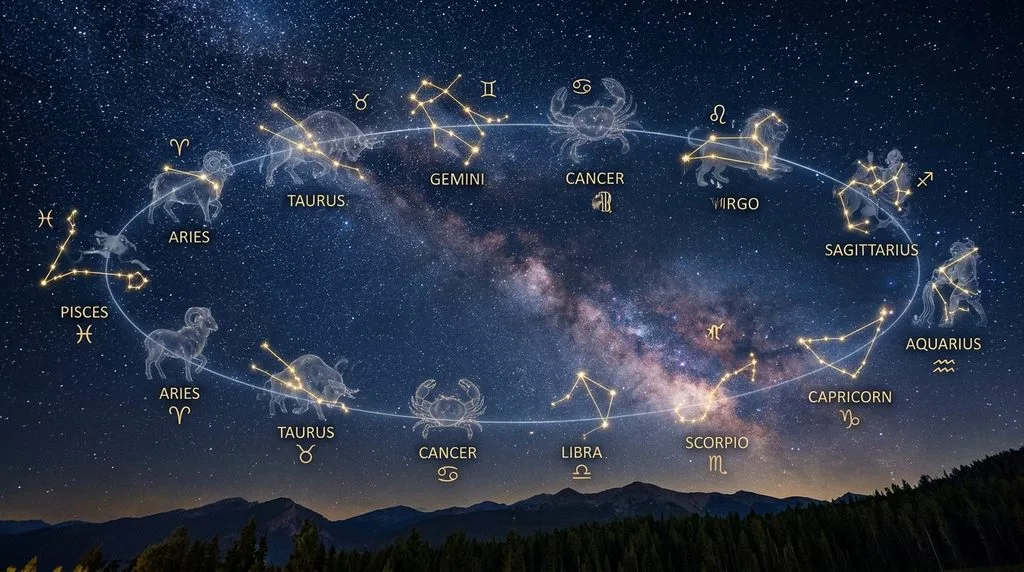
- Because of precession — a 26,000-year wobble in Earth’s axis — the actual star constellations have drifted eastward relative to the seasonal calendar. The Sun’s astronomical position today doesn’t line up with the sign dates the Babylonians set.
- In September 2016, NASA’s Space Place published a kids’ astronomy explainer noting these facts.
What’s not true:
- NASA did not change the zodiac, add a 13th sign, or reassign anyone’s sign. NASA explicitly said: “We didn’t change any zodiac signs, we just did the math.” NASA studies astronomy, not astrology — it has no authority over the astrological system.
- Western (tropical) astrology is anchored to the seasons, not the constellations. It deliberately uses 12 equal 30° slices starting at the spring equinox. Ophiuchus was known to ancient Greek astrologers, and they still used 12 signs.
- Your sign is exactly what it was last week.
The confusion comes from mixing up two different things: constellations (irregular star patterns of varying size) and zodiac signs (12 equal, mathematically divided slices of the seasonal year). They share names but they’re not the same object. Wikipedia’s astrological sign entry and the Kepler College library both walk through the tropical-vs-sidereal distinction in detail.
Sun, Moon, Rising: why your sun sign is only one-third of the story
If your sun sign never quite felt like “you,” you’re not imagining it. Your sun sign describes your core identity — your ego, your vitality, the main lesson you’re working on. But two other placements shape you just as much, and astrologers call them the Big Three:
- Sun sign: Your essence. What you’re becoming. Set by your birth date.
- Moon sign: Your inner emotional world — what makes you feel safe, how you process feelings, your private self. Set by the Moon’s position at your birth time.
- Rising sign (Ascendant): Your social mask — how strangers see you, your first impression, your default defense. Set by the sign rising over the eastern horizon at your exact birth time and place. It changes roughly every two hours, so it’s the most sensitive to exact data.
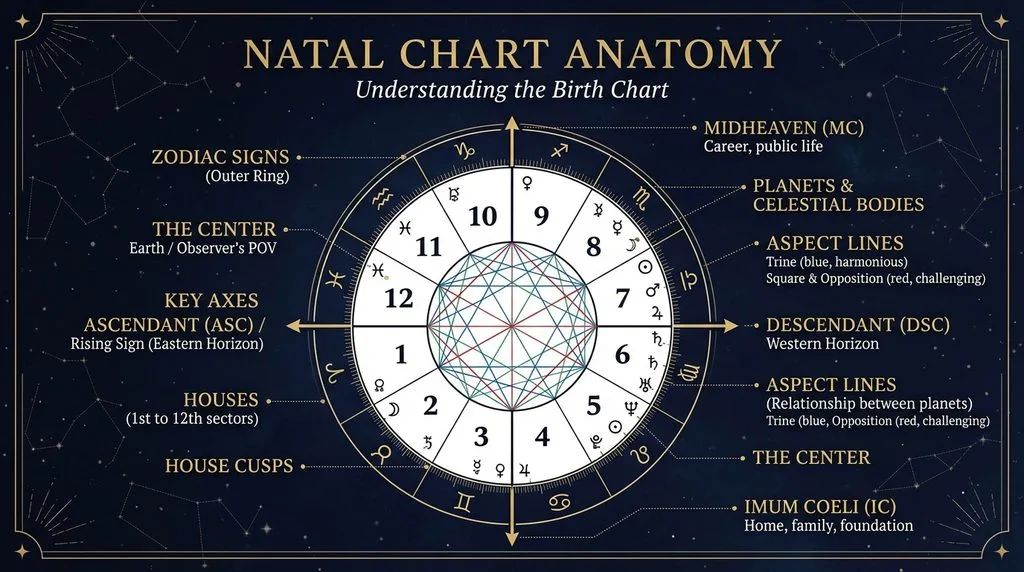
Your full natal chart (or birth chart) maps all the planets, all 12 houses, and the angles between them at your exact moment of birth. It looks like a complex wheel, and professional astrologers spend years learning to read one. The sun sign is just the front door. Allure’s sign-by-sign guide is a great next step if you want deeper personality profiles for each sign, and the Farmers’ Almanac birthday astrology guide adds birthstones, birth flowers, and seasonal context.
Western zodiac vs. Chinese zodiac: not the same thing
People sometimes mix these up, but they’re completely different systems.
| Western zodiac | Chinese zodiac | |
|---|---|---|
| Based on | Month/day of birth | Year of birth |
| Cycle | 12 signs × ~30 days = 1 year | 12 animals × 1 year = 12 years |
| Units | Aries, Taurus, Gemini… | Rat, Ox, Tiger, Rabbit, Dragon, Snake, Horse, Goat, Monkey, Rooster, Dog, Pig |
| Extra layer | Elements (fire/earth/air/water) + modalities | Five elements (Wood, Fire, Earth, Metal, Water) rotate through the 12-year cycle |
| 2026 | — | Year of the Horse (Fire Horse) |
Your Chinese zodiac animal comes from your birth year, and it changes at Chinese New Year (usually late January or February), not on January 1. So someone born in early January 2026 is still a Snake (2025’s animal), not a Horse. You can have both a Western sign and a Chinese animal — they describe different things and plenty of people enjoy reading both.
Quick ways to use your sign (that aren’t just reading horoscopes)
Once you know your sign, you can actually have fun with it beyond the daily column:
- Compatibility shortcuts: Same-element signs (fire+fire, water+water) usually click instantly. Opposite signs (Aries–Libra, Taurus–Scorpio, Gemini–Sagittarius, Cancer–Capricorn, Leo–Aquarius, Virgo–Pisces) are classic “opposites attract” pairs.
- Birthday planning: Look up your birthstone and birth flower for your sign’s month — they make genuinely thoughtful gifts. If you’re counting down to a friend’s big day, a birthday countdown keeps you from forgetting.
- Self-reflection: Even if you don’t “believe,” reading about your sign’s classic blind spots (Gemini’s scattered focus, Taurus’s stubbornness, Scorpio’s jealousy) gives you a mirror. It’s a low-stakes way to think about your habits.
- Group party games: MBTI has nothing on a room full of people arguing about whether Leos are really that dramatic.
A quick reality check
A straight answer deserves a straight caveat: astrology is not supported by scientific evidence. No peer-reviewed study has found a reliable correlation between birth month and personality, intelligence, or life outcomes. The 27% of Americans who believe in astrology (Pew, 2024) do so for cultural, entertainment, and self-reflection reasons, not scientific ones. There’s even a plausible seasonal-birth explanation for why some personality clusters seem to correlate with birth months — it’s about when you’re born relative to the school year and seasonal light exposure, not the stars.
None of that kills the fun. Millions of people read horoscopes the same way they read fortune cookies — for a smile, a nudge, or a conversation starter. Just don’t make major life decisions based on a horoscope column. Your bank account will thank you.
Frequently Asked Questions
What zodiac sign am I?
Find your birthday in the date table above. If your birthday falls on a cusp (the 1–2 day border between signs), use your exact birth time and place with a zodiac sign calculator — the changeover time varies by year.
What are the 12 zodiac signs in order?
Starting with the spring equinox: Aries, Taurus, Gemini, Cancer, Leo, Virgo, Libra, Scorpio, Sagittarius, Capricorn, Aquarius, Pisces. The cycle then repeats back to Aries.
Why do zodiac sign dates differ on some websites?
Because the exact changeover moment shifts by about a day from year to year (the equinox falls on March 19, 20, or 21). Sites use rounded “typical” dates. Only your birth year + time gives you the exact answer.
Is there really a 13th zodiac sign called Ophiuchus?
No — not in Western astrology. Ophiuchus is a real constellation the Sun passes through, but the tropical zodiac uses 12 equal seasonal slices. NASA never changed your sign; it explained the astronomy. Your sign is the same as it always was.
What’s the difference between sun sign, moon sign, and rising sign?
Your sun sign (set by birth date) is your core identity. Your moon sign (set by birth time) is your emotional inner self. Your rising sign (set by exact birth time and place) is how others see you. Together they’re called the Big Three.
Does my zodiac sign change if I move to another country?
No. Your sun sign is set at your moment of birth and never changes. Moving only matters if you’re calculating a progressed chart or relocation astrology — and even then, your natal sun sign stays fixed.
What’s the rarest zodiac sign?
In the U.S., September birthdays are the most common (Virgo), while late December/early January (Capricorn) and February (Aquarius/Pisces) are the least common — because fewer people conceive around the holidays. It’s a birth-rate pattern, not an astrological one.
Is astrology real?
Astrology is a cultural and symbolic tradition, not a science. Studies find no predictive power. Most people engage with it for entertainment, self-reflection, and community. Enjoy it, but keep your big decisions grounded in real-world facts.
Final thought
Your zodiac sign is a 2,500-year-old conversation starter — a shared language millions of people use to talk about personality, relationships, and themselves. The dates are simple once you remember two rules: every month has two signs, and cusps need your birth time. Beyond that, dive as deep (or as shallow) as you like. Whether you’re a diehard Scorpio or a skeptical Aquarius, the stars make a pretty good backdrop for figuring yourself out.