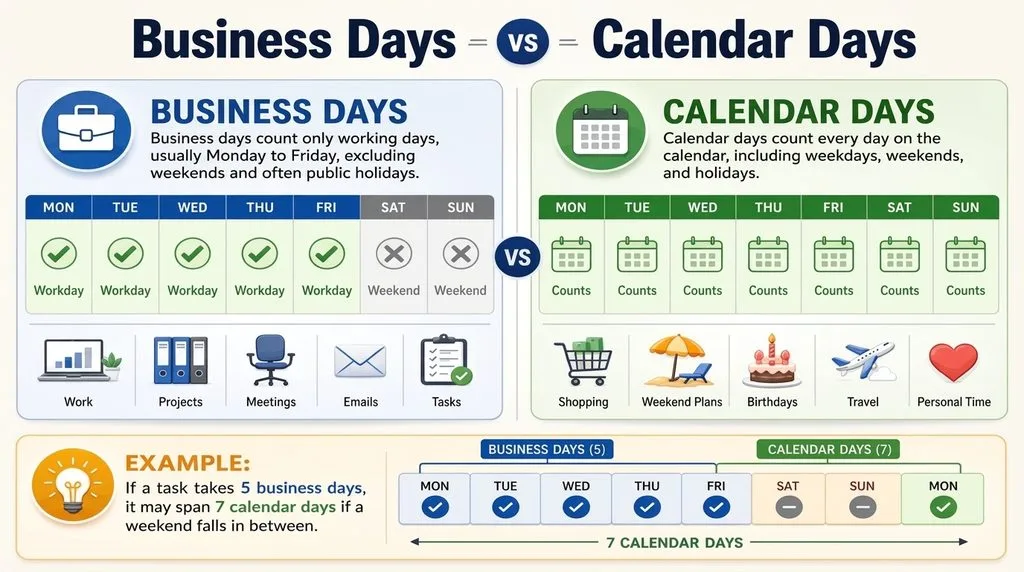

TL;DR: Calendar days count every single day on the calendar — weekends and holidays included. Business days (also called working days) count only the days offices, banks, and couriers actually operate — in the U.S., that’s typically Monday through Friday, excluding federal holidays. A “5 business day” delivery can take 7 calendar days, and a “30 days” contract clause almost always means 30 calendar days unless it explicitly says business. The rough conversion: 1 business day ≈ 1.4 calendar days, and a typical U.S. year has about 251–252 business days out of 365. When in doubt, specify which one you mean — it’s the #1 cause of missed deadlines and angry customers.
The difference at a glance
You order something on a Friday. The confirmation says “arrives in 3 days.” Does it show up Monday? Thursday? The week after? It depends entirely on whether those “3 days” are calendar days or business days — and most companies don’t make it obvious.
Here’s the side-by-side that settles it:
| Calendar Days | Business Days | |
|---|---|---|
| What counts | Every day — Mon through Sun | Only working days (usually Mon–Fri) |
| Weekends count? | Yes | No |
| Public holidays count? | Yes | No |
| Per week | 7 | ~5 |
| Per year (U.S.) | 365 (366 leap) | ~251–252 |
| Common in | Rental agreements, event countdowns, “days” with no qualifier | Shipping, banking, contracts, refunds, government deadlines |
| If you order Friday + “3 days” | Arrives Monday | Arrives Wednesday (skip Sat/Sun) |
The math is simple but the consequences are real. Because a workweek has 5 business days and a full week has 7 calendar days, business days represent roughly 71% of calendar time. That means a deadline written in business days stretches about 40% longer in real calendar time. “10 business days” sounds like a week and a half — it’s actually two full weeks (14 calendar days). “30 business days”? That’s six full weeks, or about 42 calendar days.
What does “calendar days” mean?
Calendar days are the simplest way to count time: every day counts. Saturday, Sunday, Christmas Day, your birthday — they all count exactly the same. If a lease says “rent is due within 5 calendar days of the first,” and the first is a Monday, rent is due by Saturday. No exceptions, no adjustments. This mirrors how time actually passes, which is why it’s the default in most personal, legal, and administrative settings.
The legal default matters here. If a contract, invoice, or policy just says “days” and doesn’t specify “business days” or “working days,” courts and regulators almost always interpret it as calendar days. So “Net 30” on an invoice? That’s 30 calendar days, not 30 business days. A “14-day return window”? Calendar days, including the weekends you were away. This trips people up constantly — they assume “days” means working days, and it almost never does.
Calendar days are also the right unit when the thing you’re measuring doesn’t care about office hours: a 7-day vacation, a 30-day month, a 365-day year, medication that says “take for 10 days.” Time keeps moving on weekends, and so does a calendar-day clock.
What are business days, exactly?
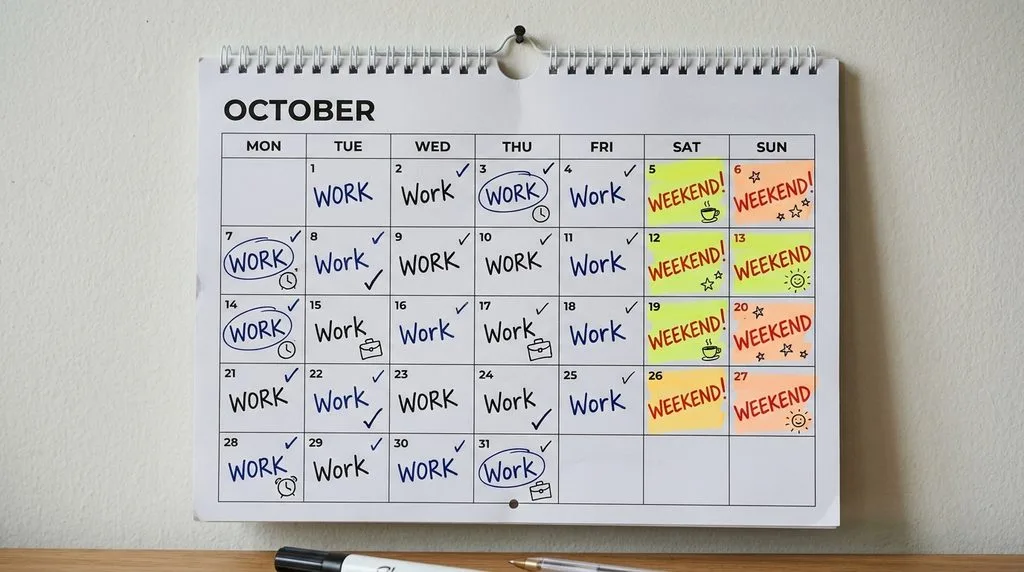
Business days meaning in one sentence: the days when the machinery of commerce is actually running. In the U.S. and most of the Western world, that’s Monday through Friday, 9 a.m. to 5 p.m., excluding public holidays. Investopedia’s definition adds a finance-specific twist: in the securities industry, any day the financial markets are open counts as a business day — which is why the U.S. stock market logs about 252 trading days per year.
What gets excluded:
- Saturdays and Sundays — the standard weekend (with one notable exception: USPS counts Saturday as a delivery day for shipping estimates, because carriers actually deliver on Saturday).
- Federal public holidays — the U.S. has 11: New Year’s Day, MLK Jr. Day, Presidents’ Day, Memorial Day, Juneteenth, Independence Day, Labor Day, Columbus Day, Veterans Day, Thanksgiving, and Christmas. When a holiday falls on a weekend, it’s observed on the nearest weekday.
- Unexpected closures — snow days, natural disasters, and (increasingly) company-wide “wellness days” can effectively pause business days, though these rarely appear in the fine print.
Wikipedia’s business day entry notes the legal nuance: U.S. federal law (5 U.S.C. § 6103) defines a business day as any calendar day except federal legal holidays — which technically includes Saturdays unless a contract says otherwise. But in everyday commerce, Saturday is almost always excluded. Some states carve out their own rules: Georgia’s consumer protection division says a business open seven days a week counts seven business days per week. And in lending, some states count Monday–Saturday (six days) as the business week. The lesson: “business day” isn’t perfectly universal — it depends on the industry and the jurisdiction.
How to calculate business days (with a real example)
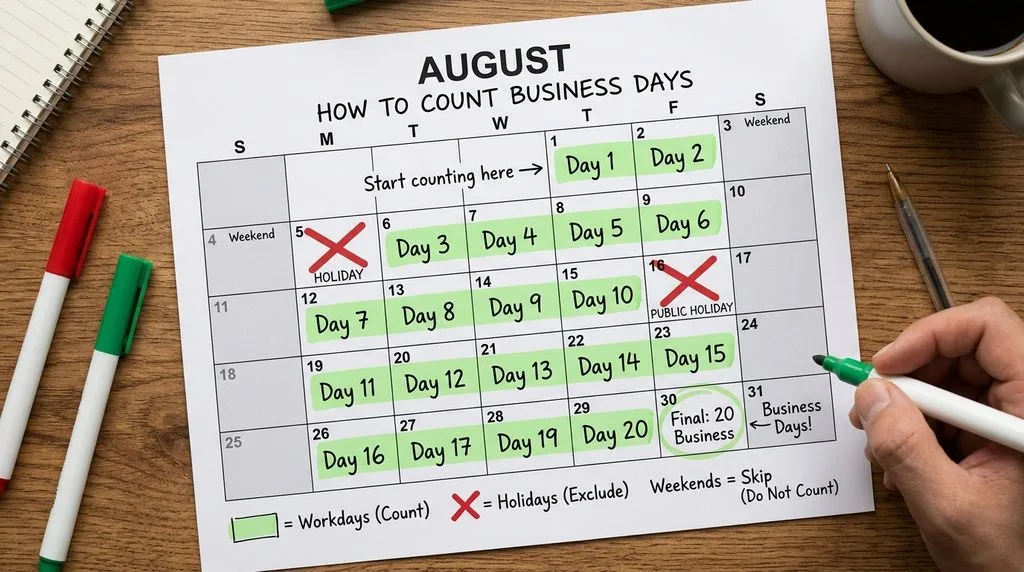
Counting business days by hand is easy once you know the trick: count forward one day at a time, and skip Saturdays, Sundays, and holidays. Let’s walk through the classic trap.
Scenario: You file a return on Friday, November 20, and the policy says “refund processed within 5 business days.” When is your money back?
| Day | Date | Count? | Running total |
|---|---|---|---|
| Day 1 | Sat, Nov 21 | ❌ Weekend | — |
| Day 2 | Sun, Nov 22 | ❌ Weekend | — |
| Day 3 | Mon, Nov 23 | ✅ | 1 |
| Day 4 | Tue, Nov 24 | ✅ | 2 |
| Day 5 | Wed, Nov 25 | ✅ | 3 |
| Day 6 | Thu, Nov 26 | ❌ Thanksgiving | — |
| Day 7 | Fri, Nov 27 | ✅ | 4 |
| Day 8 | Sat, Nov 28 | ❌ Weekend | — |
| Day 9 | Sun, Nov 29 | ❌ Weekend | — |
| Day 10 | Mon, Nov 30 | ✅ | 5 |
So “5 business days” from Friday before Thanksgiving lands on Monday, November 30 — ten calendar days later. If you’d assumed calendar days, you’d have expected the refund by November 25. That’s a five-day gap, and it’s exactly why people get frustrated.
Quick conversion cheat sheet (no holidays):
| Business days | Approx. calendar days | Real-world example |
|---|---|---|
| 1 | 1–3 | “Next business day” shipping |
| 3 | 3–5 | Standard parcel delivery |
| 5 | 7 | One full workweek |
| 10 | 14 | Two workweeks |
| 14 | ~20 | Common refund window |
| 30 | ~42 | Six workweeks |
A holiday inside the window adds one extra calendar day per holiday. A long holiday week (Thanksgiving, Christmas) can stretch a “5 business day” promise into 9 or 10 actual days. If you want to stop counting on your fingers, a date calculator handles both business-day and calendar-day math in one click.
Where the difference actually bites you
This isn’t just trivia. The calendar-vs-business distinction shows up in four places where money and deadlines are on the line.
Shipping and e-commerce. Almost every courier quotes delivery in business days because warehouses and sorting hubs close (or slow way down) on weekends. A “2 business day” order placed Friday ships Monday and arrives Wednesday — four calendar days later. Add a Monday holiday and it slips to Thursday. Processing time is usually separate from shipping time, so “1–2 business days processing + 3 business days shipping” can mean a full week before your package moves.
Banking and finance. Banks don’t process transfers, check deposits, or bill payments on weekends or federal holidays. The Consumer Financial Protection Bureau confirms that check clearing times exclude weekends and holidays, which is why a Friday deposit often doesn’t “settle” until Tuesday at the earliest. In the stock market, trades now settle in T+1 — one business day after the trade. Miss that and you can trigger a good-faith violation.
Contracts and legal deadlines. Courts and government agencies almost always count in calendar days, with a rule that if the final day lands on a weekend or holiday, the deadline rolls to the next business day. But private contracts can specify either — and the difference between “30 days” and “30 business days” is nearly two weeks. If a contract says “within 30 days,” treat it as calendar. If it says business days, it’ll say so explicitly. A 30 days from today calculator can show you exactly what that date is in either system.
Payroll and HR. Pay dates, benefits enrollment windows, and “respond within 5 business days” HR deadlines all run on business days. If your payday falls on a holiday, you usually get paid the business day before — another quirk that only makes sense once you understand how business days work.

Business days around the world (they’re not all Mon–Fri)
If you only ever deal with U.S. dates, “business day = Monday to Friday” is a safe assumption. Globally, it’s not. The workweek is shaped by religion and culture, and assuming everyone else follows your calendar is how international deadlines get missed.
| Region / Country | Typical workweek | Weekend |
|---|---|---|
| U.S., Canada, Europe, Australia | Monday–Friday | Saturday–Sunday |
| Saudi Arabia, many Muslim-majority countries | Sunday–Thursday | Friday–Saturday |
| Israel | Sunday–Thursday | Friday–Saturday |
| India, Mexico, Colombia (some sectors) | Monday–Saturday | Sunday |
| UAE (since 2022) | Monday–Friday (half-day Friday) | Saturday–Sunday |
| Japan | Monday–Friday (historically longer hours) | Saturday–Sunday |
Everhour’s business-day guide flags the most common cross-border mistake: doing business with Middle Eastern companies and assuming their Friday is your Friday. In many of those countries, Friday is the holy day and a day off — so your “3 business days” and their “3 business days” can land on completely different calendar dates. Always confirm the local workweek and holidays before setting an international deadline.
Business day vs working day vs business hours (the subtle distinctions)
People use these terms interchangeably, and they’re not quite the same. Getting them straight prevents a lot of confusion.
- Business day: A day on which business can be conducted — defined by the calendar (Mon–Fri, minus holidays). It’s a unit of time, usually a full 24-hour block.
- Working day: A day on which a specific person actually works. A nurse working Tuesday through Saturday has working days that include Saturday, even though Saturday isn’t a business day. A firefighter works Sundays; that’s a working day but not a business day.
- Business hours: The hours within a business day when a company is actually open — typically 9 a.m. to 5 p.m., but a bank might close at 4 p.m. and a retail store might stay open till 9. A “same business day” cutoff usually means “before our business hours end,” and ordering at 6 p.m. Friday often means your order doesn’t start processing until Monday.
Germany makes this distinction explicit in law. A Werktag is any calendar day except Sunday and public holidays — it includes most Saturdays. An Arbeitstag is a day someone actually works, typically Monday–Friday. Most of the English-speaking world lumps these together, which is why “is Saturday a business day?” has no single clean answer. It depends on who’s asking and what industry they’re in.
How to calculate both with tools (stop counting on your fingers)
Once you know the concept, let software do the arithmetic. The fastest tools:
| Tool | Formula / function | What it does |
|---|---|---|
| Excel / Google Sheets | =WORKDAY(start_date, days, [holidays]) | Adds business days to a date, skipping weekends and your holiday list |
| Excel / Google Sheets | =NETWORKDAYS(start_date, end_date, [holidays]) | Counts business days between two dates |
| Excel / Google Sheets | =DAYS(end_date, start_date) | Counts calendar days between two dates |
| Python | numpy.busday_count() | Business-day counting in code |
| Online | Date calculator / business days calculator | Paste two dates, get both counts |
The Excel WORKDAY function is the one finance and operations teams live by. If you type =WORKDAY("2026-11-20", 5) it returns the date 5 business days later, automatically skipping the weekend. Add a range of holiday dates as the third argument and it skips those too. Quidlo’s business-day deep dive notes that this is how payroll teams avoid missing holiday-shifted pay dates.
Common mistakes (and how to avoid them)
Even professionals trip over this. The most frequent errors:
- Assuming “days” means business days. It almost always means calendar days. If someone wanted business days, they’d have written “business days.”
- Forgetting holidays inside the window. A 5-business-day estimate around Christmas can stretch to 9 or 10 calendar days. Always check the holiday calendar between start and end.
- Counting the start day. Does “within 3 business days” from Friday include Friday? Most contracts say no — the clock starts the next business day. When in doubt, ask.
- Ignoring the cutoff time. “Ships same business day” usually means “if ordered before 2 p.m.” Order at 3 p.m. and it effectively ships the next business day.
- Applying your local workweek internationally. A Friday deadline to a Saudi partner lands on their weekend. Confirm their holidays too.
- Mixing processing time and shipping time. “1–2 business days processing + 3 business days shipping” is 4–5 business days total, not 3.

Frequently Asked Questions
What are business days?
Business days are the days when offices, banks, and couriers operate — in the U.S., typically Monday through Friday, excluding federal public holidays. They’re used for shipping, banking, contracts, and any deadline that pauses on weekends.
What does calendar days mean?
Calendar days count every day on the calendar, including weekends and holidays. If a deadline says “10 days” with no qualifier, it almost always means 10 calendar days.
Is Saturday a business day?
Usually no — Saturday is part of the weekend. Exceptions: USPS counts Saturday for shipping estimates, some retailers and banks operate limited Saturday hours, and some state laws (like Georgia lending) count Monday–Saturday. When in doubt, check the company’s policy.
How many calendar days is 5 business days?
Roughly 7 calendar days (one full week). If a holiday falls inside the window, add one extra calendar day per holiday. Ordering on a Friday can stretch 5 business days to 7–9 calendar days.
How many business days in a year?
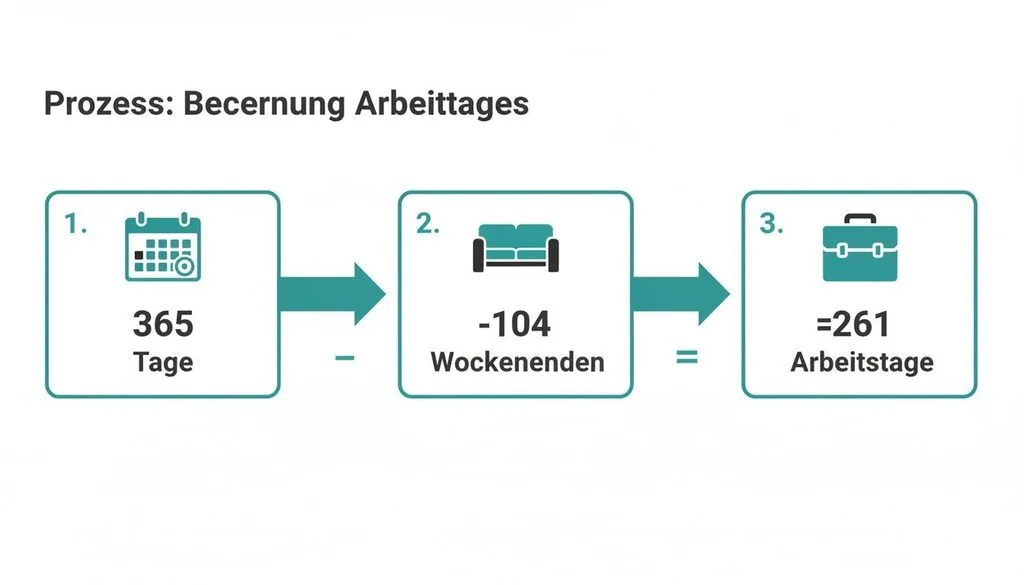
In the U.S., about 251–252 business days per year. That’s 365 calendar days minus ~104 weekend days minus ~10–11 federal holidays. The stock market logs about 252 trading days.
Do holidays count as business days?
No. Federal and most state holidays are excluded from business-day counts. If a holiday falls on a weekend, it’s observed on the nearest weekday, which removes that weekday from the count too.
What’s the difference between business days and working days?
A business day is a calendar concept (Mon–Fri minus holidays). A working day is personal — the days a specific person actually works. A nurse working weekends has working days that include Saturdays, which aren’t business days.
If a contract says “30 days,” is that calendar or business days?
Calendar days. Legal default is calendar days unless the document explicitly says “business days” or “working days.” “30 calendar days” is about 4–5 weeks; “30 business days” is about 6 weeks — a big difference.
Final thought
The gap between calendar days and business days is one of those tiny, boring details that costs real money and real patience — a missed refund window, a late invoice payment, a package that “should have arrived by now.” The fix is simple: never write or accept just “days” in a deadline. Say “calendar days” or “business days,” add the cutoff time, and check the holiday calendar. Do that, and you’ll never again find yourself arguing with a support rep about whether their “3 days” included the weekend.