The CRISPE framework is a five-part structure for writing ChatGPT prompts — Capacity/Role, Insight, Statement, Personality, and Experiment — that turns vague questions into expert-level answers. Created by GitHub program director Matt Nigh and popularized through his open-source prompt library, CRISPE has since been cited in peer-reviewed medical research and adopted by marketing, product, and consulting teams worldwide.
Most people write ChatGPT prompts the same way they type into a search bar. A search bar wants keywords. ChatGPT wants a brief — the kind you’d hand to a smart new employee on their first day. CRISPE gives you a repeatable brief format that eliminates guesswork and delivers strong output on the first try.
This guide covers every component, gives you real copy-paste prompts, compares CRISPE against faster alternatives, and shows you exactly how to build a personal library that keeps compounding.
🔑 TL;DR — Key Takeaways
- CRISPE stands for Capacity/Role, Insight, Statement, Personality, and Experiment.
- Created by Matt Nigh as a free, open-source prompt structure and later validated by peer-reviewed research in orthopedic AI.
- Use CRISPE for complex, high-stakes prompts — strategy documents, expert content, sales enablement, and thought leadership.
- Works with ChatGPT, Claude, Gemini, and Perplexity because it enforces the five variables every LLM responds to.
- Beginners fail mainly by skipping Insight and Personality — the two ingredients that separate generic output from publishable output.
- You can master CRISPE in an afternoon and use it forever.
📇 Quick Reference Card — CRISPE at a Glance
| Slot | Question It Answers | 3-Word Example |
|---|---|---|
| C/R — Capacity & Role | Who should ChatGPT be? | “Senior tax attorney” |
| I — Insight | What context does it need? | “$180K LLC, California” |
| S — Statement | What exactly do you want? | “Three legal strategies” |
| P — Personality | What tone or voice? | “Direct, jargon-free” |
| E — Experiment | How many variations? | “Three ranked options” |
Screenshot this table, keep it in your notes app, and you’ll never write a weak prompt again.
What Is the CRISPE Framework?
CRISPE is a structured method for writing prompts to large language models. It gives you a five-slot checklist that stops you from forgetting the details ChatGPT actually needs to produce a strong answer.
Think of it as the difference between a shopping list and a recipe card. A shopping list (“eggs, flour, sugar”) gives ChatGPT ingredients but no instructions. A recipe card (“mix 2 eggs, 1 cup flour, and 3 tbsp sugar, bake at 350°F for 20 minutes, top with vanilla glaze”) gives it a repeatable outcome.
A National Institutes of Health viewpoint paper published in September 2025 documented how CRISPE reduces “insufficient and conflicting responses” in medical AI research, where prompt quality directly affects clinical decisions. The same principle transfers across every knowledge-work domain — better structure produces better outputs, every time.
Where Did the CRISPE Framework Come From?
Matt Nigh, a Program Manager Director at GitHub who runs AI enablement programs, created CRISPE and published it inside a free open-source GitHub repository focused on ChatGPT prompts. The project — originally titled “ChatGPT-Free-Prompt-List” and now rebranded as PromptBin — remains publicly available under the MIT license.
Key milestones in CRISPE’s adoption:
- 2023 — Nigh publishes the framework inside a free public GitHub repository.
- 2024 — CRISPE appears in academic research on LLM-generated metaheuristic algorithms.
- September 2025 — Featured in a National Institutes of Health viewpoint paper on ChatGPT accuracy in orthopedics.
- 2026 — Adopted inside Fortune 500 AI-enablement programs and taught at business schools worldwide.
The framework’s staying power comes from simplicity. It’s memorable, printable on a sticky note, works with any LLM, and can be taught to a full team in twenty minutes.
Why Should You Use a Prompt Framework at All?
You can write great prompts without a framework. Most people don’t, though — because writing without structure means reinventing what a good prompt should include every single time.
Three benefits show up almost immediately when you adopt a structured approach:
- Consistent quality — every prompt clears the same minimum bar.
- Faster iteration — you edit one variable at a time instead of rewriting from scratch.
- A reusable library — winning prompts become templates you save and adapt for years.
OpenAI’s official ChatGPT prompt engineering guide reinforces the same core principles: be specific, provide context, iterate. CRISPE is essentially a memorable shortcut that packages those principles into a repeatable format anyone on your team can learn quickly.

What Do the Five Letters in CRISPE Stand For?
CRISPE combines five components that map to the five decisions every strong prompt has to make. “C” and “R” share one slot — Capacity/Role — which is why some sources describe CRISPE as five components while others count six.
| Letter | Component | What It Controls |
|---|---|---|
| C/R | Capacity & Role | Who the AI should be |
| I | Insight | The background it needs |
| S | Statement | The exact task you want done |
| P | Personality | The tone and voice |
| E | Experiment | How many variations you want |
Master this table and you’ve mastered 80% of the framework. The next five subsections show you how to fill each slot with real substance.
C/R — Capacity and Role
Capacity and Role tells ChatGPT who to be before it produces anything.
- Weak: “Help me with taxes.”
- Strong: “Act as a Certified Public Accountant with 15 years of experience filing U.S. small-business returns.”
The role changes vocabulary, assumptions, and even the follow-up questions ChatGPT asks. A “helpful assistant” and a “senior CPA” answer the exact same question in completely different ways.
I — Insight
Insight provides the context, background, and constraints the AI cannot guess. This is the single most-skipped step — and where most poor prompts collapse.
- Include: audience, industry, product, past decisions, non-negotiables.
- Example: “The business is a two-person marketing consultancy earning $180K/year in gross revenue, structured as an LLC in California. We want to reduce self-employment tax exposure without triggering audit risk.”
Without Insight, ChatGPT gives generic answers. With Insight, it starts genuinely problem-solving.
S — Statement
Statement is the explicit task. Keep it verbatim — one clear ask, phrased as a directive verb.
- Weak: “Give me some tax ideas.”
- Strong: “Recommend three legal tax-reduction strategies specific to my situation, ranked by ease of implementation.”
Every strong prompt has exactly one main Statement. If yours contains “and also” three times, split it into multiple prompts.
P — Personality
Personality shapes tone, voice, and format. It’s the difference between a whitepaper and a Twitter thread.
- Examples: “Confident but conversational, like a Vox explainer article,” “Direct and stripped-down, like a Ryan Holiday email,” “Formal, third-person, no contractions.”
Personality is what makes ChatGPT sound like your brand rather than a generic AI voice.
E — Experiment
Experiment asks ChatGPT to produce multiple variations for comparison. This is the secret weapon most users never turn on.
- Example: “Give me three versions — one aggressive, one moderate, one conservative.”
- Why it works: you get a menu instead of a single guess, which dramatically speeds up iteration.
Once you build the Experiment habit, you’ll stop treating ChatGPT’s first draft as the final draft.
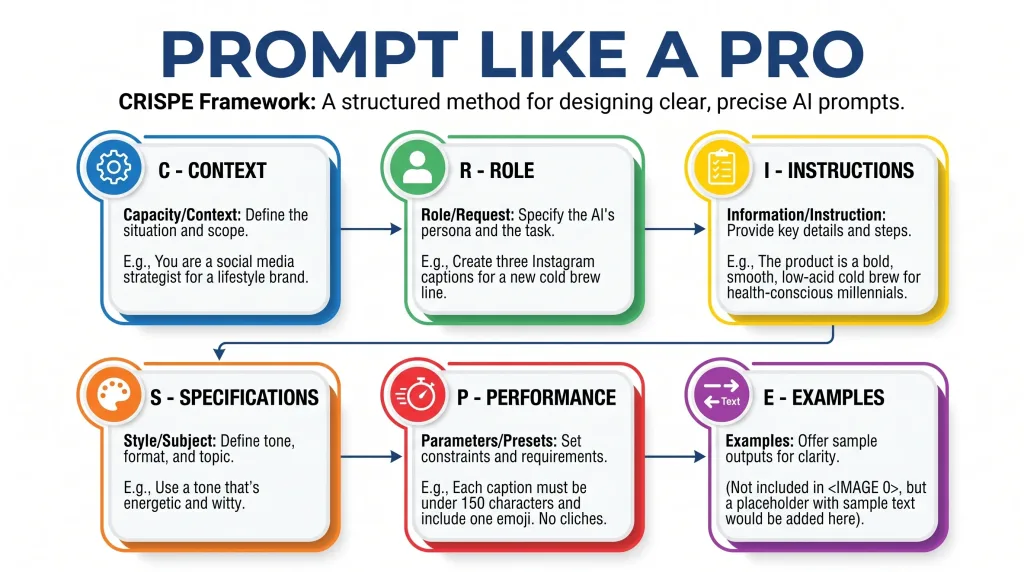
What Does a Full CRISPE Prompt Actually Look Like?
Here’s the same task written three ways so you can feel the quality jump.
🎯 Task: “Write a cold email to book a discovery call.”
❌ Random prompt:
“Write me a cold email to book a discovery call.”
Result: A generic template you’ve seen a thousand times.
✅ CRISPE prompt:
Capacity/Role: Act as a senior B2B copywriter who has written cold outreach for Salesforce, HubSpot, and Notion.
Insight: I sell a $299/month AI-powered inbox tool that saves customer-support teams 12 hours a week. My target reader is the Head of Customer Support at a Series-B SaaS company with 100–500 employees.
Statement: Write a 95-word cold email to book a 15-minute discovery call.
Personality: Warm, human, low-pressure — no jargon, no “circling back,” no “hope this finds you well.”
Experiment: Give me three versions with different subject lines and different opening hooks.
Result: Three publishable emails, one clear winner, ready to A/B test.
The prompt is longer, but you write it once and save it forever. For a deeper walkthrough of the underlying five-block system CRISPE is built on, my earlier guide to prompt engineering breaks it down step by step.
How Does CRISPE Compare to Other Prompt Frameworks?
CRISPE is not the only framework — it’s one of the most balanced. Here’s how it stacks up against the four other frameworks you’ll see most often in 2026.
| Framework | Components | Best For | Complexity |
|---|---|---|---|
| RTF | Role, Task, Format | Fast, everyday prompts | ⭐ Low |
| CRISPE | Capacity/Role, Insight, Statement, Personality, Experiment | Deep analysis, strategy, expert content | ⭐⭐⭐ Medium |
| CO-STAR | Context, Objective, Style, Tone, Audience, Response | Brand-aligned copywriting | ⭐⭐⭐ Medium |
| RISEN | Role, Instructions, Steps, End goal, Narrowing | Multi-step operational tasks | ⭐⭐ Medium |
| APE | Action, Purpose, Expectation | Very short creative sprints | ⭐ Low |
Pick the right framework for the job:
- Use RTF when you’re moving fast and the task is common.
- Use CRISPE when the output has to feel expert, on-brand, or nuanced.
- Use CO-STAR when you need marketing copy that matches a house style.
- Use RISEN when the AI has to complete a step-by-step operational task.
- Use APE when you just need a quick creative sprint.
For a broader library of advanced prompting patterns like chain-of-thought and self-consistency, the DAIR.AI Prompt Engineering Guide is the most-cited open resource in the field.
Which Real-World Situations Benefit Most From CRISPE?
CRISPE isn’t the fastest framework, so use it where the extra structure pays for itself. These are the highest-return use cases across professions:
- Marketing — brand messaging, email sequences, ad variations, positioning documents.
- Sales — cold outreach, discovery-call scripts, objection-handling libraries.
- Product — PRDs, feature briefs, user research synthesis, competitive analyses.
- Content and writing — long-form articles, thought-leadership posts, ghostwritten LinkedIn.
- Research — literature reviews, comparative analyses, hypothesis generation.
- Consulting and coaching — proposals, discovery frameworks, personalized playbooks.
- Healthcare — patient-education drafts and clinical decision-support drafts (with human review).
For profession-specific templates you can copy into ChatGPT right now, my library of ChatGPT prompts for writers contains 120+ CRISPE-style prompts organized by workflow stage.
What Does CRISPE Look Like by Profession?
Different jobs need different flavors of CRISPE. Here’s a starter cheat sheet for seven common roles.
| Profession | Capacity/Role Example | Personality Tip |
|---|---|---|
| Marketer | “Senior brand strategist at a $50M CPG company” | “Punchy, benefit-first, no marketing clichés” |
| Sales rep | “Enterprise AE who closed $50M+ ARR in SaaS” | “Direct, curious, one-question-per-turn” |
| Founder | “Series-A operator who scaled from $1M to $10M ARR” | “Practical, plain-English, focused on tradeoffs” |
| Writer | “Longform journalist with credits in The Atlantic” | “Story-first, no jargon, evidence-driven” |
| Developer | “Senior software engineer with 10 years in Python” | “Concise, code-first, explain only when asked” |
| Consultant | “McKinsey engagement manager, EM-level” | “Structured, MECE, quantifiable when possible” |
| Educator | “High school AP teacher with 15 years experience” | “Scaffolded, examples-first, patient tone” |
Copy the row that matches your role and drop it into the C/R slot next time you prompt ChatGPT.

When Should You Not Use the CRISPE Framework?
CRISPE is powerful, but it’s overkill for many everyday tasks. Skip it when:
- The task is under 10 words. For “summarize this email,” plain English wins.
- You’re brainstorming. Loose, exploratory prompts unlock creativity better than rigid structure.
- You need speed above quality. For quick internal notes, RTF or a one-liner is fine.
- You’re testing a new model. Start simple to see the model’s baseline behavior.
- The task doesn’t need a persona. If tone is irrelevant, skip Personality entirely.
The rule is simple: use CRISPE when quality matters, and skip CRISPE when speed matters. Both are valid.
What Are the Most Common CRISPE Mistakes?
Almost every beginner runs into the same pitfalls. Fix these five and your outputs improve overnight.
- Skipping Insight. Without context, ChatGPT falls back to generic answers. Always name the audience, the goal, and any constraints.
- Overloading the Statement. One prompt equals one main ask. If your Statement has “and also” more than twice, split it into two prompts.
- Vague Personality. “Professional tone” tells the AI almost nothing. Reference a real style (like “a Vox explainer” or “a Ryan Holiday email”).
- Ignoring Experiment. Asking for two or three variations costs nothing and speeds up iteration dramatically.
- Using CRISPE for everything. Not every prompt needs five slots. Match the framework to the stakes.
The goal isn’t to force CRISPE onto every prompt. It’s to use CRISPE when the output has to be great, and use lighter tools when it just needs to be fast.
How Do You Adapt CRISPE for ChatGPT, Claude, and Gemini?
CRISPE is model-agnostic, but each major model has small preferences worth learning:
- ChatGPT (GPT-5 series) — responds strongly to explicit Personality directives and Experiment variations. Add “3 versions” to almost any creative prompt.
- Claude (Anthropic) — rewards longer Insight blocks. Claude reasons better when you over-explain context rather than under-explain it.
- Gemini (Google) — integrates cleanly with Workspace data. Add Insight that references specific Google Docs, Sheets, or Drive files you’ve shared.
- Perplexity — favors sources. Add “Cite at least three current sources” inside your Statement for research work.
- Open-source models (Llama, Mistral, DeepSeek) — benefit most from explicit Capacity/Role, since they lack ChatGPT’s default persona layer.
The five slots stay identical. Only the emphasis shifts.
Can CRISPE Prompts Help You Rank in AI Overviews?
Yes — and this is one of the most under-discussed uses of the framework. When you use ChatGPT to draft blog content with CRISPE, you can bake in AI-search-friendly formatting from the very first draft. Google’s own AI-optimization guidance confirms that structured, people-first content is what wins citations in AI Overviews and AI Mode.
Use a CRISPE prompt like this when drafting content for search:
- C/R: Act as an SEO content strategist who writes for AI Overview citations.
- I: My topic is [X]. My target keyword is [Y]. My audience is [Z].
- S: Draft a 1,800-word blog post with question-based H2s, a TL;DR block, an 8-question FAQ section, and answer passages of 40–60 words at the top of each H2.
- P: Simple, active voice, short paragraphs.
- E: Give me two versions with different narrative angles so I can pick the stronger one.
The result: draft content that already meets the structural requirements AI search engines look for. That saves hours of editing and dramatically improves your chances of being cited by ChatGPT, Perplexity, and Google AI Overviews.
How Do You Build a Personal CRISPE Prompt Library?
Your library is your compounding asset — the professional equivalent of a chef’s private recipe book. Here’s the four-step system that scales:
- Save every winner. When a prompt produces excellent output, copy it into a single doc, Notion database, or Airtable base.
- Tag by use case. Add tags like
email,blog-outline,sales-script,research. Retrieval speed matters more than volume. - Version them. When you improve a prompt, save the new version next to the old one so you can see what changed.
- Review monthly. Once a month, spend fifteen minutes scanning your library. Delete the underperformers. Promote the winners into templates.
Within six months of consistent library-building, you’ll have 50–100 templates ready to reuse. That’s when prompt engineering stops being a skill and becomes a personal moat.
What Is the 5-Step Workflow for Writing a Great CRISPE Prompt?
Follow this loop and your prompt quality compounds week over week.
- Define the outcome. Write one sentence describing what “good” looks like before you touch ChatGPT.
- Draft each slot. Fill in Capacity/Role, Insight, Statement, Personality, and Experiment in order.
- Read the draft aloud. If any slot sounds vague, it is. Add specifics.
- Run it. Read ChatGPT’s output critically — what’s missing, wrong, or generic?
- Refine one variable and re-run. Change only Insight, or only Personality, so you learn what actually improved the answer.
That last step separates casual users from real prompt engineers. Each iteration teaches you which variables matter most for your specific use case.
What Are Three Real CRISPE Prompts You Can Steal Today?
Copy any of these into ChatGPT, swap the bracketed placeholders, and watch the difference.
1. LinkedIn Thought-Leadership Post
C/R: Act as a ghostwriter for solo founders who’ve built newsletters with 10,000+ subscribers.
I: I’m a [industry] founder. I want to share a specific lesson I learned from [event / mistake / experiment]. My audience is [target reader], mostly on LinkedIn.
S: Write a 180-word LinkedIn post that starts with a curiosity hook, tells the story in scenes, and ends with one clear takeaway.
P: Warm, direct, no emojis, no motivational-poster clichés.
E: Give me three versions with different opening hooks.
2. Sales Discovery-Call Prep
C/R: Act as a senior enterprise SaaS account executive who’s closed $50M+ in ARR.
I: I have a discovery call tomorrow with the VP of Operations at [company]. They’re a [industry] company with [employee count] employees. My product is [one-sentence description].
S: Give me the five questions I should ask to qualify this opportunity and the top three objections I should be ready to handle.
P: Direct, plain-English, no filler.
E: Rank the questions from highest-signal to lowest-signal.
3. Long-Form Blog Outline
C/R: Act as an SEO content strategist who specializes in AI Overview–optimized content.
I: My topic is [topic]. My target keyword is [keyword]. My audience is [reader profile]. Competing content ranks by [what competitors do well and where they fail].
S: Build a 2,500-word blog outline with H2s, H3s, and one-sentence descriptions of what each section should cover.
P: Structured like a Semrush blog post — question-based H2s, scannable, informative.
E: Give me two versions with different narrative angles.
Save the winners in your library. That library becomes your compounding advantage.
What Are the Most Common Objections to CRISPE — and the Honest Answers?
“It takes too long to write.”
Only on your first ten prompts. After that, filling five slots is faster than editing a bad output three times.
“My prompts already work fine.”
They probably work at 60–70% of the ceiling. CRISPE pushes that to 90%+ with the same input cost.
“Frameworks feel restrictive.”
CRISPE isn’t a cage — it’s a checklist. Once you internalize it, you can bend or skip slots based on the situation.
“I’ll forget the acronym.”
Screenshot the Quick Reference Card above. Read it three times. You’ll have it memorized before lunch.
“My team won’t adopt it.”
Every team resists new process. Show them one before-and-after comparison and adoption becomes self-driven.
What’s the Future of CRISPE and Prompt Frameworks?
Some argue that AI will get so smart that prompt structure won’t matter. The evidence points in the opposite direction.
- Model capability is growing, but so is model steerability. Better models reward better inputs, not worse ones.
- Agentic AI raises the stakes. When AI executes multi-step actions on your behalf, precision matters more, not less.
- Multimodal prompting — text plus image plus voice plus video — is opening entirely new workflows in design, medicine, and education.
- Team standardization is becoming a competitive advantage. Companies that adopt shared prompt frameworks ship faster than teams that don’t.
CRISPE will probably evolve or get replaced by something newer in a few years. The skill of writing structured prompts, however, will only grow in value. Learn CRISPE now and the muscle memory carries into whatever comes next.
Frequently Asked Questions
Is CRISPE better than the RTF framework?
Neither is universally better — they solve different problems. RTF is faster and works for 80% of everyday prompts. CRISPE wins for strategic, high-stakes, or brand-sensitive work where nuance matters.
Do I have to use all five CRISPE components every time?
No. Capacity/Role, Insight, and Statement are the non-negotiable core. Personality and Experiment are optional power-ups you add when you want on-brand output or multiple variations to compare.
Does CRISPE work with Claude, Gemini, and Perplexity?
Yes. The framework is model-agnostic because it enforces the five variables every language model responds to — role, context, task, style, and variation. Only the emphasis shifts between models.
Who created the CRISPE framework?
Matt Nigh, a Program Manager Director at GitHub, created CRISPE and published it in his open-source prompt-list repository. The framework was later cited in academic AI research and a National Institutes of Health viewpoint paper.
Is CRISPE overkill for simple prompts?
Yes, for anything under two sentences. Use CRISPE when the output has to be publishable, on-brand, or expert-level. Use RTF or plain English for quick summaries and brainstorms.
How long does it take to learn CRISPE?
Most people learn the five slots in fifteen minutes. Building the muscle memory to draft strong CRISPE prompts on the first try takes about a week of daily practice.
Can I combine CRISPE with chain-of-thought prompting?
Yes — this combination is one of the highest-leverage moves in prompt engineering. Add “think through this step by step before answering” inside your Statement, and CRISPE’s structure plus chain-of-thought reasoning delivers significantly better results on complex tasks.
What’s the biggest mistake beginners make with CRISPE?
Skipping Insight. Without context, ChatGPT falls back on generic training patterns. Fill Insight thoroughly and roughly 70% of prompt quality problems disappear immediately.
Final Thoughts
The CRISPE framework isn’t magic — it’s a memory aid. It reminds you to give ChatGPT the five things it actually needs to produce a great answer instead of a generic one. Skip Insight and you get clichés. Skip Personality and you get robotic prose. Skip Experiment and you settle for the first draft. Fill all five slots and you get output that feels like it came from an expert who understood exactly what you needed.
Start today. Pick one recurring prompt in your work — a weekly LinkedIn post, a client discovery script, a blog outline — rewrite it in CRISPE format, and save the winning version. Three months from now, you’ll have a personal library of prompts that keeps compounding while everyone else is still typing “help me with…” into ChatGPT.
That’s the entire secret. Structure your inputs, and ChatGPT gives you structured, expert-level outputs — every single time.