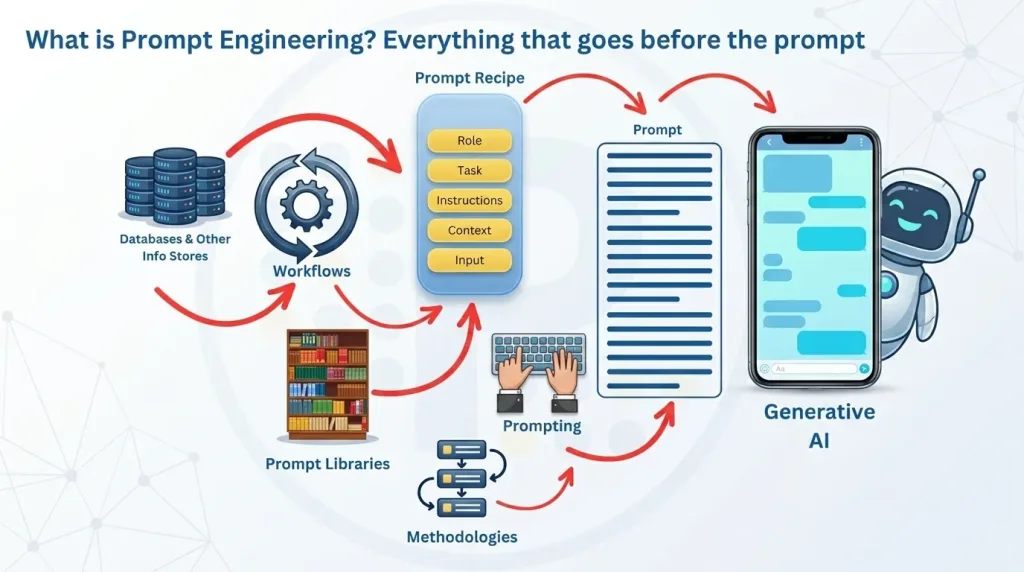

Prompt engineering is the practice of writing clear, structured instructions that guide an AI model to produce the exact output you want. Think of it as learning how to ask a very smart but very literal assistant. In 2026, this one skill decides whether ChatGPT gives you a forgettable paragraph or a business-ready deliverable — and the professionals who master it now earn a median of $126,000 per year in the United States, per Coursera’s December 2025 salary data.
Here’s a quick “before and after” that shows the difference.
- ❌ Weak prompt: “Write me a marketing plan.”
- ✅ Strong prompt: “Act as a B2B SaaS marketing director. Write a 30-day launch plan for a $29/month project-management tool aimed at freelance designers. Include weekly goals, one paid channel, one organic channel, and a KPI per week. Return the plan as a Markdown table.”
Same model. Same task. Wildly different output. That gap — between vague and precise — is exactly what prompt engineering is about. This guide walks you through the entire foundation, without jargon, and with prompts you can copy today.
🔑 TL;DR — Key Takeaways
- Prompt engineering is the skill of writing structured inputs that steer AI models like ChatGPT, Claude, Gemini, and Perplexity toward accurate, useful outputs.
- Every strong prompt contains five building blocks: role, task, context, constraints, and output format.
- The most-used frameworks in 2026 are RTF, CRISPE, CO-STAR, RISEN, and Chain-of-Thought.
- The biggest beginner mistakes are being vague and asking for too many things in one prompt.
- Coursera’s latest data pegs the U.S. median salary at $126,000, with a typical range of roughly $63,000–$126,000 depending on experience and industry.
- You can start improving any output within two minutes using the simple 6-step workflow below.
What Does Prompt Engineering Actually Mean?
Prompt engineering is the process of designing text inputs — called prompts — that instruct a large language model (LLM) to generate a specific type of response. The name sounds technical, but the practice is simple: you give the AI the right role, context, and constraints, and it gives you dramatically better answers.
Think of a prompt as a brief you’d hand to a talented but new team member. If your brief is one sentence, they guess. If your brief includes their role, the goal, the audience, and the format you want, they deliver something usable on the first try.
That’s the entire mental shift. You’re not “asking a question” — you’re writing a brief. For deeper conceptual background on how modern AI models work, Google AI publishes accessible primers on large language models, multimodal systems, and reasoning.
Why Does Prompt Engineering Matter So Much in 2026?
AI adoption jumped from novelty to necessity in less than three years. Semrush’s 2026 AI SEO research reports that Google’s AI Overviews now reach roughly 2 billion monthly users, and about 35% of U.S. Gen Z now use AI chatbots to search for information. Whoever writes the prompt controls the output — and the output increasingly drives real decisions inside businesses, classrooms, and creative work.
Three reasons this skill matters right now:
- Output quality scales linearly with prompt quality. The same model can produce a mediocre answer or an expert-level one depending purely on how you ask.
- It’s the highest-leverage AI skill you can learn. You can’t tune a model, but you can absolutely tune the input — for free, in seconds.
- It transfers across every tool. ChatGPT, Claude, Gemini, Perplexity, Midjourney, and coding assistants like Copilot all reward the same core principles.
How Does an AI Model Actually Read Your Prompt?
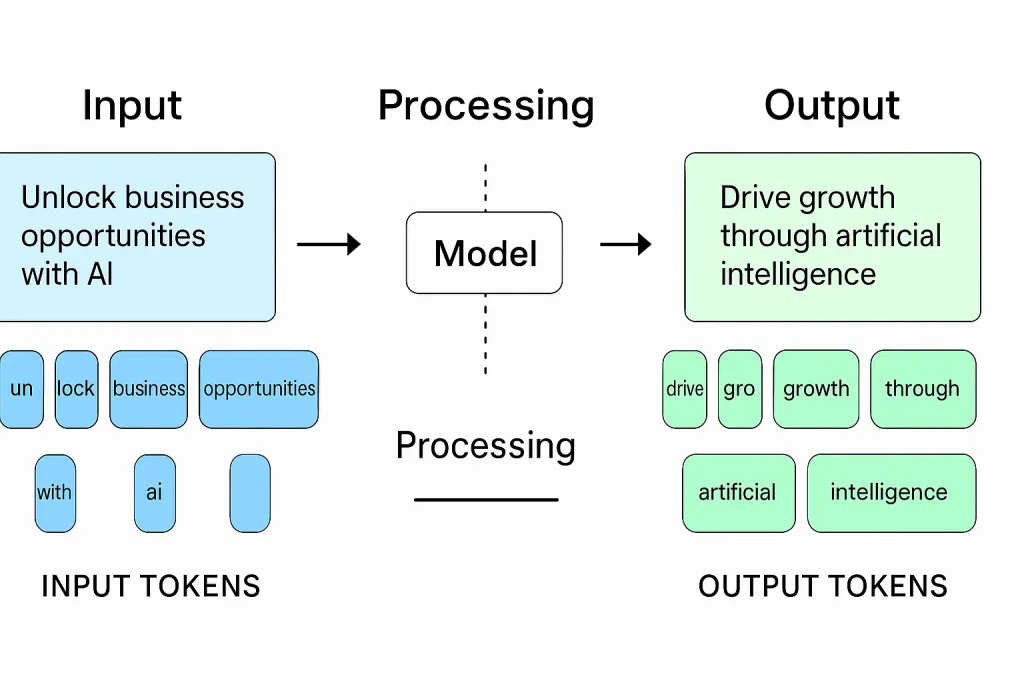
Large language models don’t understand your prompt the way a person does. They predict the most likely next token — a word or word-piece — based on everything you’ve written so far. Your job is to make the “most likely” answer also the correct answer.
Every prompt gets processed through four internal stages:
- Tokenization — your text is broken into small chunks the model can process.
- Context loading — the model builds a working memory of everything in your prompt.
- Pattern matching — it compares your instruction against patterns seen during training.
- Sequential generation — it predicts each next token one at a time, biased by everything above.
The practical takeaway: specific words carry weight. Saying “as a senior tax accountant” activates a very different set of patterns than “like someone who knows taxes.” Small vocabulary changes cause big output changes.
What Are the Five Building Blocks of a Great Prompt?
Every high-quality prompt — whether you use ChatGPT, Claude, or Gemini — contains the same five elements. Learn these once and you can build any prompt from scratch.
| Building Block | What It Does | Example |
|---|---|---|
| Role | Sets the AI’s persona and expertise level | “Act as a senior UX researcher.” |
| Task | States the exact deliverable | “Analyze this survey data and list 5 insights.” |
| Context | Provides background, audience, and goals | “The product is a Notion competitor for lawyers.” |
| Constraints | Adds limits, tone, and rules to follow | “Keep it under 300 words. Avoid buzzwords.” |
| Output format | Defines structure and length | “Return a Markdown table with columns: Insight, Evidence, Action.” |
Once you know the blocks, most prompts become fill-in-the-blank exercises rather than blank-page struggles. That’s the entire skill in one sentence.
What Are the Best Prompt Engineering Techniques?
Beyond structure, three core techniques unlock huge quality gains once you know when to apply each. These appear in nearly every serious 2026 guide on prompt engineering.
1. Zero-Shot Prompting
You give the model an instruction with no examples. It relies purely on what it learned during training.
- Use it when: the task is common and well-defined.
- Example: “Translate the following sentence into French: ‘The train leaves at 8 p.m.’”
2. Few-Shot Prompting
You provide two to five examples of the pattern you want, then ask the model to continue it.
- Use it when: you need a specific style, format, or edge case handled.
- Example: “Product: Wireless mouse → Tagline: Click freely. Product: Standing desk → Tagline: Rise and thrive. Product: Air purifier → Tagline:”
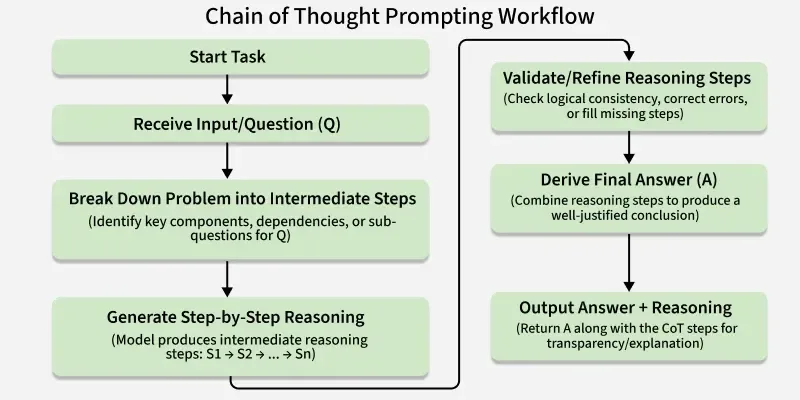
3. Chain-of-Thought (CoT) Prompting
You instruct the model to show its reasoning step by step before giving an answer. Introduced by Wei et al. in 2022, CoT dramatically improves accuracy on math, logic, and multi-step problems.
- Use it when: the problem requires reasoning, not recall.
- Trigger phrase: “Let’s think step by step.”
Google Research reports that combining Chain-of-Thought with a 540B-parameter PaLM model lifted state-of-the-art GSM8K math-benchmark accuracy from 55% to 58%, and self-consistency-enhanced CoT reached 74% on the same benchmark. On sports-reasoning tasks the same technique surpassed unaided human sports enthusiasts (95% vs. 84%). You can read the technical breakdown on the Google Research blog.
4. Role Prompting
You tell the model who to be, not just what to do. This narrows its style, vocabulary, and default assumptions.
- Example: “Act as a patent lawyer with 15 years of software experience.”
5. Iterative Prompting
You start with a rough prompt, read the output, then refine and re-ask. Every serious professional does this — no one writes a perfect prompt on attempt one.
What Are the Most Popular Prompt Engineering Frameworks?
Frameworks are simply named acronyms that remind you which building blocks to include. You don’t need to memorize all of them — pick two and use them until they feel natural.
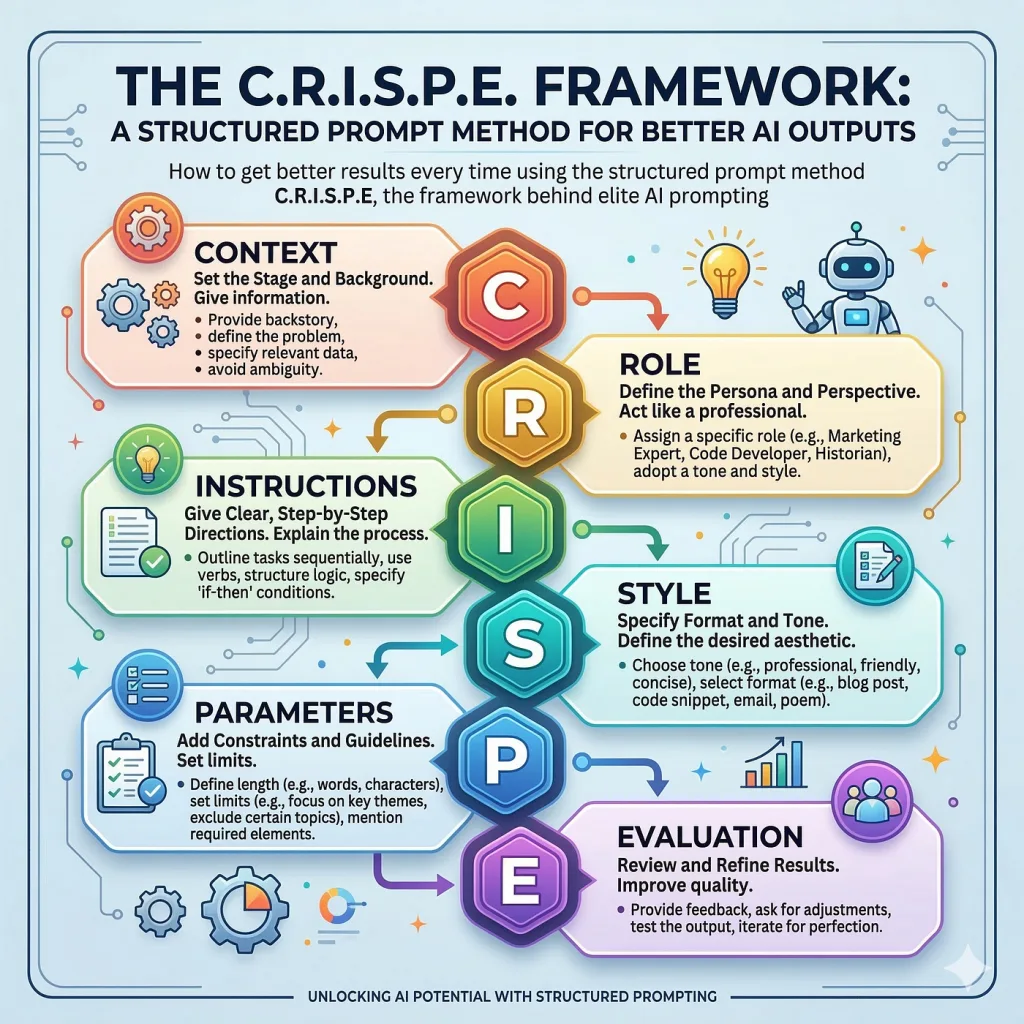
Here’s a clean comparison of the five most-used frameworks in 2026:
| Framework | Stands For | Best For |
|---|---|---|
| RTF | Role, Task, Format | Fast, everyday prompts |
| CRISPE | Capacity & Role, Insight, Statement, Personality, Experiment | Deep analysis and expert-level answers |
| CO-STAR | Context, Objective, Style, Tone, Audience, Response | Marketing, copy, and brand-aligned content |
| RISEN | Role, Instructions, Steps, End goal, Narrowing (constraints) | Multi-step operational tasks |
| APE | Action, Purpose, Expectation | Very short, direct asks |
The RTF Framework — Your Everyday Default
If you learn only one framework, learn RTF. It covers about 80% of daily prompting needs.
- R (Role): Who should the AI act as?
- T (Task): What is the specific job?
- F (Format): How should the output look?
Example RTF prompt:
“Act as a senior email marketing specialist (Role). Write a 3-email welcome sequence for new subscribers to a personal-finance newsletter (Task). Return each email as a labeled block with subject line, preview text, and body under 180 words (Format).”
The CRISPE Framework — For Complex Work
CRISPE is heavier but powerful when you need thoughtful, nuanced answers.
- C — Capacity & Role: the persona the AI adopts (e.g., “senior data analyst with fintech experience”).
- R is part of the combined “Capacity & Role” position in the original framework.
- I — Insight: background context, audience, and business goal.
- S — Statement: the exact task in plain language.
- P — Personality: the desired tone and voice.
- E — Experiment: ask for multiple variations to compare.
For creative and strategic work, CRISPE consistently outperforms shorter frameworks in blind prompt tests. If you want to go deeper into structured prompting patterns, the Prompt Engineering Guide is the most-cited open resource in the field.
What Does a Great Prompt Look Like in Practice?
Let’s walk through the same task at three quality levels — beginner, intermediate, and expert — so you can feel the difference.
🎯 Task: “Help me write a LinkedIn post about launching my freelance business.”
❌ Beginner prompt:
“Write me a LinkedIn post about starting my freelance business.”
Result: A generic, cliché-heavy post that could belong to anyone.
⚠️ Intermediate prompt:
“Write a LinkedIn post announcing my new freelance UX design business. Keep it professional but personal. About 150 words.”
Result: Better, but still forgettable. No hook, no voice, no story.
✅ Expert prompt:
“Act as a LinkedIn ghostwriter for solo founders. Write a 180-word announcement post that I (a former in-house UX designer at a fintech startup) am launching a freelance UX practice focused on B2B SaaS onboarding flows. Start with a curiosity hook, include one specific past win (redesigned an onboarding flow that lifted activation 34%), and end with a soft CTA to DM me for a free 20-minute audit. Voice: warm, direct, no emojis, no motivational-poster clichés. Return only the final post text.”
Result: Publishable in one draft.
Notice the difference isn’t length. It’s specificity — every phrase reduces the model’s uncertainty about what “good” looks like.
What Are the Most Common Prompt Engineering Mistakes?
Almost every beginner makes the same handful of mistakes. Fix these and your outputs improve overnight.
- Being vague. “Give me some marketing ideas” is not a prompt — it’s a wish. Specify audience, offer, channel, and goal.
- Cramming too much into one prompt. Combining research + writing + editing forces the model to compromise on all three. Split them into separate calls.
- Skipping the role. Without a role, you get generic writing. With one, you get expert framing.
- Not defining output format. Without a format, you may get 800 words when you needed a 5-row table.
- Refusing to iterate. Nobody writes a perfect prompt on attempt one. Read the output, refine one variable, ask again.
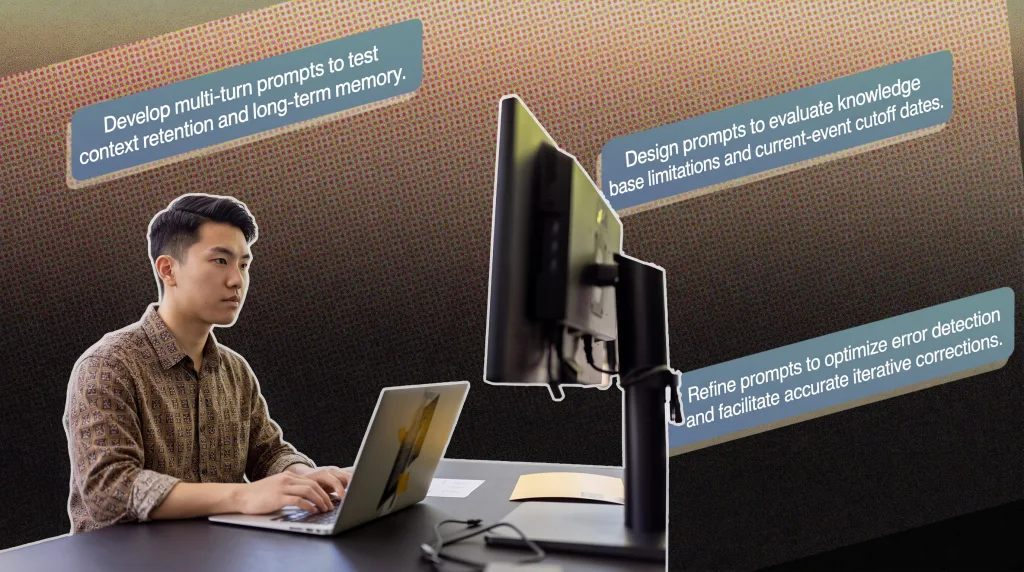
- Ignoring context windows. Very long prompts can push earlier instructions out of the model’s attention. Put the most important rules at the top and the bottom.
- Assuming AI knows current events. Many models still have knowledge cutoffs. If the task depends on recent data, provide the data or use a tool with browsing enabled.
What Is the 6-Step Prompt Engineering Workflow?
Follow this repeatable loop and your prompts will improve every day.
- Define the outcome first. Write one sentence describing what “good” looks like — before opening ChatGPT.
- Choose a framework. Start with RTF for speed or CRISPE for depth.
- Draft the prompt using the five building blocks (role, task, context, constraints, format).
- Run it and read critically. Ask: what’s missing, what’s wrong, what’s too generic?
- Refine and re-run. Adjust exactly one element at a time so you learn what caused the change.
- Save it. Every winning prompt goes into a personal prompt library you can reuse forever.
This last step is what separates casual users from real prompt engineers. Your library becomes your compounding asset — the professional equivalent of a chef’s private recipe book.
Which Tools Should You Use to Practice Prompt Engineering?
You don’t need a paid tool to start. The free tiers of major AI platforms cover 95% of what beginners need.
- ChatGPT (OpenAI) — the most-used LLM for everyday tasks and iteration.
- Claude (Anthropic) — strongest for long-form writing, reasoning, and nuanced tone.
- Gemini (Google) — deeply integrated with Google Workspace; ideal for research-heavy queries.
- Perplexity — the cited-source AI search engine, best for research and up-to-date facts.
- Mistral, Llama, DeepSeek — open-source models you can run locally when privacy matters.
For teams and creators who want to version, test, and share prompts the way engineers manage code, prompt-management platforms like PromptLayer are becoming standard tooling in 2026.
What Are the Real-World Use Cases for Prompt Engineering?
Every knowledge worker in 2026 benefits from prompt engineering, but a few use cases produce outsized returns.
- Content creation: blog outlines, email sequences, social captions, ad copy, landing pages.
- Coding: writing functions, debugging errors, generating tests, explaining legacy code.
- Research and analysis: summarizing PDFs, comparing options, extracting insights from surveys.
- Customer support: drafting replies, building FAQ answers, generating help-center articles.
- Personal productivity: planning meals, structuring workouts, preparing for interviews, drafting difficult emails.
- Learning: turning any topic into a personalized tutor session.
- Business operations: creating SOPs, meeting agendas, board updates, hiring rubrics.
The pattern across all of these is the same: a small time investment in a good prompt saves hours of downstream work.
How Much Can You Earn as a Prompt Engineer in 2026?
Prompt engineering is a real, well-paid role — and the earning potential extends to any job that adopts it as a supporting skill.
Coursera’s December 2025 salary data reports these figures for U.S. prompt engineers:
- Median total pay: approximately $126,000 per year
- Typical range: roughly $63,000 (entry) to $126,000 (mid-senior), with specialist roles reaching higher in enterprise SaaS, healthcare AI, fintech, and legal tech
- Highest-paying industries: AI research labs, enterprise SaaS, and regulated verticals like healthcare and legal
Even if you don’t chase “prompt engineer” as a job title, the skill boosts earning power across every role that touches content, code, research, or customer communication. If you want a structured learning path, Coursera hosts a full library of prompt-engineering courses and certifications from Google, IBM, Vanderbilt, and DeepLearning.AI — several of which are auditable for free.
What’s the Future of Prompt Engineering?
Some pundits argue AI will get so smart that prompts won’t matter. The evidence points the opposite direction.
- Model capability is growing, but so is model steerability. Better models reward better inputs, not worse ones.
- Agentic AI raises the stakes. When an AI is executing multi-step actions on your behalf, precise instructions matter more, not less.
- New prompting techniques keep emerging. Tree-of-thought, self-consistency, and retrieval-augmented prompting are already showing measurable gains.
- Multimodal prompting — combining text, image, voice, and video — is opening entirely new workflows in design, medicine, and education.
The core skill of communicating clearly with machines is only going to grow more valuable. Prompt engineering isn’t going away; it’s becoming as foundational as knowing how to use a search engine was in 2005.
Frequently Asked Questions
1. Is prompt engineering hard to learn?
Not at all. The fundamentals — role, task, context, constraints, and output format — can be learned in a weekend. Getting great at it takes about three to six months of daily practice, mostly by iterating on real prompts for real work.
2. Do I need to know how to code to become a prompt engineer?
Not for basic prompt engineering. However, engineers who also understand Python, APIs, and how LLMs consume tokens earn significantly more and take on more advanced roles like building AI agents and retrieval-augmented systems.
3. What’s the difference between zero-shot and few-shot prompting?
Zero-shot prompting gives the AI an instruction with no examples. Few-shot prompting provides two to five examples of the desired pattern before asking the model to continue. Use few-shot when you need a specific style, format, or tone the AI wouldn’t guess on its own.
4. Which prompt engineering framework should I start with?
Start with RTF (Role, Task, Format). It’s the fastest to memorize and works for about 80% of everyday tasks. Once RTF feels natural, layer in CRISPE for complex analysis or strategy work.
5. Can prompt engineering work across ChatGPT, Claude, Gemini, and Perplexity?
Yes. The core principles are model-agnostic. Each model has small quirks — Claude prefers longer, more contextual prompts; Perplexity rewards source-focused questions — but the same five building blocks apply everywhere.
6. How do I keep improving my prompts over time?
Build a personal prompt library. Every time a prompt produces excellent output, save it with a short note about what worked. Reviewing your own library monthly compounds your skill faster than any course can.
7. Is prompt engineering still a good career in 2026?
Yes, though the role is maturing. Pure “prompt engineer” titles are converging with adjacent roles like AI product manager, AI content strategist, and AI systems engineer. The underlying skill is more valuable than ever — it’s just being embedded into more job descriptions.
8. What’s the single biggest mistake beginners make?
Being vague. If your prompt could be sent to five different people and produce five wildly different results, the AI will do the same thing. Add a role, add constraints, and specify an output format — and about 70% of quality problems disappear immediately.
Final Thoughts
Prompt engineering is the single highest-leverage skill you can learn in 2026 for the smallest amount of upfront investment. A weekend of deliberate practice puts you ahead of the average AI user. A month of daily iteration puts you ahead of the average professional. And a personal prompt library — quietly compounding in the background — puts you ahead of the average expert within a year.
Start today. Pick one task you’d normally handle in ChatGPT, apply the RTF framework, save the result, and repeat tomorrow. Three months from now, you’ll be genuinely surprised at how differently AI responds to you compared to everyone else in the room.