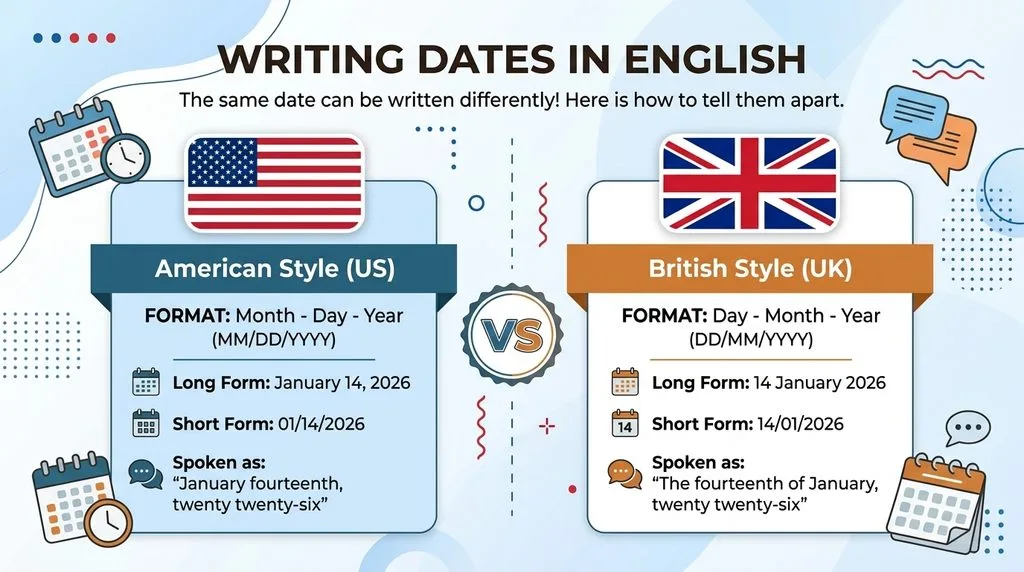

Quick answer: There are two main ways to write the date in English. American English puts the month first: October 17, 2026 (or 10/17/2026). British English puts the day first: 17 October 2026 (or 17/10/2026). For anything international, the safest format is the ISO standard: 2026-10-17. Pick one format and use it consistently. If you ever need the fully spelled-out version for an invitation, certificate, or legal document, you can convert date to words in one click — it writes out “the seventeenth of October, two thousand and twenty-six” perfectly, so you never misspell an ordinal or fumble a century.
Let me tell you about the time I almost missed a flight. I booked with “05/06/2026” written in my notes, fully meaning June 5. The airline’s system read it May 6. I showed up a month late. Okay, that is a slight exaggeration — but I have definitely stared at a date and thought, “wait, which one is this?” If you have ever done the same, you are in exactly the right place.
Writing the date sounds like the simplest thing in the world until you have to do it in front of someone. Do you put the month first or the day? Do you need a comma? Is it “17th” or just “17”? Where does the date go on a formal letter? Why does everyone around you seem to write it differently? By the end of this guide, you will know exactly how to write the date in every situation — emails, letters, essays, resumes, wedding invitations, and international contracts. We will cover everything the top guides cover, plus the gaps they leave. Grab a coffee and let’s go.
1. The Two Big Formats: American vs British
The single most important thing to understand is that English has two dominant date conventions, and they are exact opposites. Once you know which one your reader expects, everything else falls into place.
- American English (US, Canada, Philippines): Month – Day – Year. Example: October 17, 2026. Month comes first, comma separates day from year.
- British English (UK, Australia, New Zealand, India, most of Europe): Day – Month – Year. Example: 17 October 2026. Day comes first, no comma.
| Format | Order | Written out | All numbers | Comma? |
|---|---|---|---|---|
| American | Month Day, Year | October 17, 2026 | 10/17/2026 | Yes, before year |
| British | Day Month Year | 17 October 2026 | 17/10/2026 | No |
| International (ISO) | Year-Month-Day | 2026-10-17 | 2026-10-17 | No |
Why the difference? Americans say “October seventeenth” out loud, so they write the month first. British speakers often say “the seventeenth of October,” so the day leads. Neither is wrong — they just grew up differently. The official American format traces back to colonial customs, while the British format matches most of the rest of the world.
My golden rule: if you know your reader, match their convention. If you are writing for a mixed or international audience, spell the month out in letters — “October 17” or “17 October” — so there is zero ambiguity. That one habit prevents 99% of date disasters.
2. All-Numeric Dates: Fast but Dangerous
All-numeric dates are quick, but they are also the most dangerous thing you can put in an international email. “03/04/2026” means March 4 to an American and 3 April to a British reader — a 31-day gap, enough to miss a flight, a deadline, or a wedding.
| Numeric date | American reads it as | British reads it as |
|---|---|---|
| 03/04/2026 | March 4, 2026 | 3 April 2026 |
| 12/05/2026 | December 5, 2026 | 12 May 2026 |
| 01/02/2026 | January 2, 2026 | 1 February 2026 |
Some countries use dots (17.10.2026) or hyphens (17-10-2026) instead of slashes, but the order rule stays the same. If you ever fill out an online form and cannot tell which format it wants, look for hints in the labels — “MM/DD/YYYY” means American, “DD/MM/YYYY” means British. When in doubt, type the month in letters; most forms accept it.
3. Saying Dates Aloud and Ordinal Numbers
When you speak a date, you almost always use ordinal numbers. “October 17” is pronounced “October seventeenth,” and “17 October” is often pronounced “the seventeenth of October.” In writing, though, modern style prefers plain numbers (17, not 17th). Both are correct — the suffixes just feel slightly more formal or old-fashioned.
The ordinal pattern is simple, with three famous teen exceptions:
| Number | Ordinal | Rule |
|---|---|---|
| 1 | 1st | -st |
| 2 | 2nd | -nd |
| 3 | 3rd | -rd |
| 4–20 | 4th, 5th … 20th | -th |
| 21, 31 | 21st, 31st | -st (like 1) |
| 22, 32 | 22nd, 32nd | -nd (like 2) |
| 23, 33 | 23rd, 33rd | -rd (like 3) |
| 11, 12, 13 | 11th, 12th, 13th | Always -th — the big exception |
That last row trips up everyone. It is never “11st,” “12nd,” or “13rd.” The teens all take -th. Memorize that one line and you will never mislabel an ordinal again. For wedding invitations, certificates, and legal documents where the date must be fully spelled out, writing “the seventeenth of October, two thousand and twenty-six” by hand invites typos — the tool I mentioned at the top handles it instantly and error-free.
4. Months: Names, Numbers, and Abbreviations
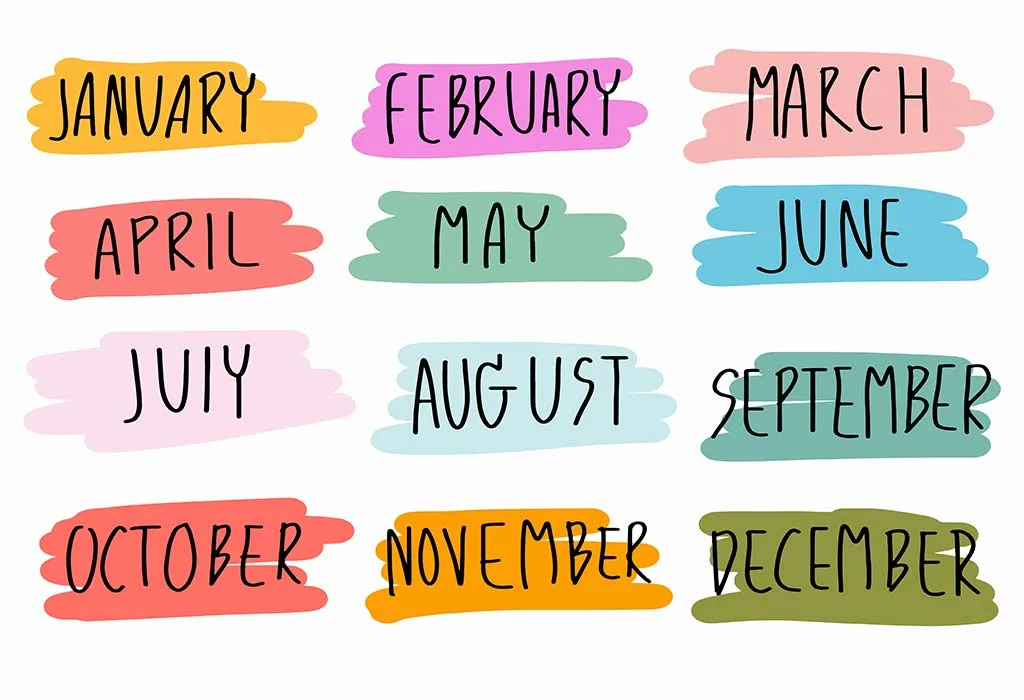
Every date starts with a month, so let’s get these nailed. January is month 1, December is month 12 — and that number is exactly what makes numeric dates work (and what makes them confusing across borders).
| # | Month | Abbreviation | Days |
|---|---|---|---|
| 1 | January | Jan. | 31 |
| 2 | February | Feb. | 28 (29 in leap years) |
| 3 | March | Mar. | 31 |
| 4 | April | Apr. | 30 |
| 5 | May | May | 31 |
| 6 | June | June | 30 |
| 7 | July | July | 31 |
| 8 | August | Aug. | 31 |
| 9 | September | Sep. or Sept. | 30 |
| 10 | October | Oct. | 31 |
| 11 | November | Nov. | 30 |
| 12 | December | Dec. | 31 |
Always capitalize the month — it is a proper noun. Abbreviations are fine in notes, tables, and informal writing, but spell the month out in formal letters and academic work. May, June, and July are so short we rarely abbreviate them at all.
5. Adding the Day of the Week and the Time
Want to include the weekday? It always goes first, followed by a comma, then the date.
- American: Friday, October 17, 2026
- British: Friday, 17 October 2026
In American style, if the full date sits in the middle of a sentence, you need a second comma after the year: “The meeting on Friday, October 17, 2026, has been moved.” That second comma is the one most people forget. In British style, because there is no comma between day and month, you usually do not add one after the year either.
When you add a time, it comes after the date, usually with “at”: Friday, October 17, 2026, at 3:00 PM. Use a comma before “at” in American style when the full date precedes it. Times themselves can be 3 p.m., 3 PM, or 15:00 — pick one and be consistent.
A quick preposition cheat sheet: use on with days and dates (on Friday, on October 17), in with months and years (in October, in 2026), and at with clock times (at 3:00). That trio alone will fix most date-related grammar slips.
6. Where to Put the Date on a Formal Letter
This is the question that pops up right before you print and sign something. In a formal letter, the date goes at the very top, before the recipient’s address. In modern block-style letters — the most common format — everything aligns to the left margin, so the date sits flush left with one blank line above it and two below it. In older modified-block style, the date aligns to the right or center. Either is fine; just match the rest of your letter.
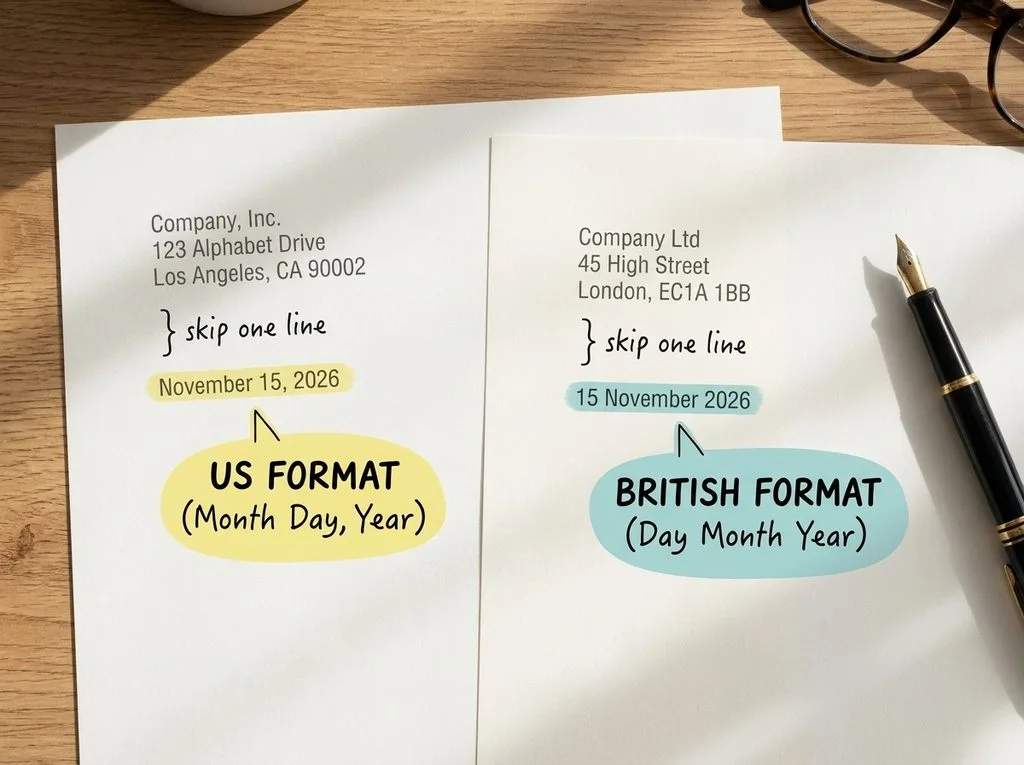
For the date itself, write the month in full — “October 17, 2026” (American) or “17 October 2026” (British). Abbreviations like “Oct.” read as slightly careless in a formal letter. Skip the ordinal suffix in modern professional correspondence; “October 17” is cleaner and preferred by most current style guides. In an email, you usually do not need to write the date at all — the email client stamps it automatically.
On a resume, dates are usually just month and year, right-aligned: Oct 2023 – Present. On a wedding invitation, spell everything out: “Saturday, the seventeenth of October, two thousand and twenty-six.” Different occasions, different rules — now you know both.
7. Style Guides: APA, MLA, Chicago, and AP
If you write for school, work, or journalism, your organization probably has a style guide. Here is how the big four handle dates, so you never lose points for formatting.
| Style guide | Date format | Example |
|---|---|---|
| APA | Month Day, Year (American) | October 17, 2026 |
| MLA | Day Month Year, month abbreviated | 17 Oct. 2026 |
| Chicago | Month Day, Year, month spelled out | October 17, 2026 |
| AP (journalism) | Month abbreviated with specific date | Oct. 17, 2026 |
If you are taking the IELTS exam, good news: both American and British formats are accepted. The examiners just want consistency — mixing them can cost you accuracy marks. Pick one before you start writing and stick with it. That single tip is worth more than any grammar rule.
8. The International Standard: ISO 8601
If you write anything technical — filenames, databases, contracts, flight itineraries — meet your new best friend: ISO 8601. The format is YYYY-MM-DD: four-digit year, two-digit month, two-digit day, separated by hyphens. Today would be 2026-10-17.
Why it is brilliant:
- Nobody misreads it. Year first means no American/British confusion.
- It sorts perfectly. Files named “2026-10-17-report.pdf” line up chronologically in any folder.
- It is machine-friendly. Every spreadsheet, database, and programming language understands it.
- It is the official international standard, used by governments, airlines, and tech companies worldwide.
You do not need it on a birthday card. But for anything that crosses borders or needs sorting, ISO 8601 is the grown-up choice.
9. Decades, Centuries, and Years
Dates are not just single days. Here is how to handle the bigger units.
- Decades: the 1990s or the ’90s. No apostrophe before the s — it is a plural, not a possessive. “The 1990’s” is a common mistake.
- Centuries: the 1800s or the nineteenth century. Spell out centuries in formal writing (“the nineteenth century”); use numerals casually (“the 1800s”).
- Years: always four digits in formal writing (2026, not ’26). Two-digit years are fine in informal notes.
- BC/AD or BCE/CE: BC goes after the year (44 BC); AD can go before or after (AD 44 or 44 AD). BCE and CE both go after the year (44 BCE, 44 CE).
The full history of how we settled on these conventions is surprisingly interesting — the calendar date has been argued about for thousands of years, and we are still not 100% consistent.
10. Common Mistakes and How to Avoid Them
After years of editing, these are the date mistakes I see most often. Avoid them and your writing will look instantly more polished.
- Mixing formats in one document. Pick American or British and use it everywhere.
- All-numeric dates in international email. Write the month in letters. Always.
- Forgetting the second comma. “On July 4, 1776, the declaration was signed” needs both commas.
- Adding a comma in British style. “17 October, 2026” looks wrong to British readers.
- Writing “11st,” “12nd,” “13rd.” The teens are always 11th, 12th, 13th.
- Abbreviating the month in a formal letter. Spell it out.
- Two-digit years on legal or financial documents. Always write 2026 in full.
If you ever need to count days between two dates — how many days until a deadline, how long a project lasted, or when a 90-day warranty expires — a date calculator does the math in one click, leap years and all.
Final Thought
Writing the date is one of those tiny skills nobody teaches you properly but everyone expects you to know. The good news is that once you see the American/British split, the comma rules, and the ISO 8601 escape hatch, it all clicks. You will stop second-guessing yourself mid-email. You will stop worrying that your London reader booked the wrong day. And honestly? You will probably start noticing everyone else’s date mistakes — which is its own little superpower.
Frequently Asked Questions
How do you write the date correctly?
In American English, write Month Day, Year — October 17, 2026. In British English, write Day Month Year — 17 October 2026. For international or technical use, ISO 8601 (2026-10-17) is completely unambiguous. Pick one format and use it consistently.
How do Americans write the date?
Americans use Month-Day-Year: October 17, 2026, or numerically 10/17/2026. A comma always separates the day from the year. If the date falls mid-sentence, add a second comma after the year.
How do British people write the date?
British English uses Day-Month-Year: 17 October 2026, or numerically 17/10/2026. No comma is used between month and year. This format is also used in Australia, New Zealand, India, and most of Europe.
Where do you put the date on a formal letter?
The date goes at the very top, before the recipient’s address. In modern block-style letters it aligns left, with one blank line above and two below. In modified-block style it aligns right or center. Spell the month out fully and skip the ordinal suffix in professional correspondence.
What is January’s month number?
January is month number 1. February is 2, March is 3, through December at 12. The month number is what makes numeric dates work — and why 01/02 means different days in the US vs the UK.
Do you write 17th or 17 in a date?
Both are correct. Modern formal and professional writing prefers the plain number: October 17, 2026. The ordinal form (October 17th) is acceptable in more casual or traditional writing. When speaking, you always say “the seventeenth.”
Why is 04/05/2026 ambiguous?
Americans read it as May 4 (month first); British readers read it as 5 April (day first). To avoid confusion, write the month in letters — May 4, 2026 or 4 May 2026 — or use ISO format: 2026-05-04.
What date format should I use for IELTS?
Both American and British formats are accepted in IELTS. The key is consistency — mixing formats can lower your accuracy marks. Choose one before you start and use it throughout your writing.