

TL;DR: Our Quick Picks
- Best low-cost overall: Fidelity Go — zero advisory fee under $25,000; start with $10.
- Best for guidance & goals: Betterment — $5/mo or 0.25%/yr; human CFP upgrade available.
- Best for automation & taxes: Wealthfront — 0.25%/yr; daily tax-loss harvesting.
- Best for building the habit: Acorns — invests your spare change; $4/month and up.
- Best free all-in-one: SoFi Invest — zero-commission trading; robo-advisor from $50.
- Best for self-directed learners: Robinhood — free trades plus Cortex AI summaries; use with discipline.
- Best pure AI research assistant: Magnifi — ask investing questions in plain English; free tier available.
An AI investing app is a platform that uses machine learning and automated algorithms to build, rebalance, and optimize a portfolio for you — so you don’t have to pick individual stocks or watch the market daily. For a complete beginner, the right answer in 2026 is simple: start with Fidelity Go or Betterment, invest a small amount automatically every payday, and don’t check the app every day. If you want a deeper, side-by-side comparison of the same field, our companion guide to AI investing apps walks through every tier in detail. This article focuses on what the AI actually does, what each app really costs, and how to avoid the beginner mistakes that cost real money.
Before You Invest: Do These 3 Things First
An AI app can grow your money, but it works best on a stable foundation. Do these in order:
- Pay off high-interest debt. Credit cards charging 20%+ APR beat any realistic investment return. Clear those first.
- Build a starter emergency fund. Keep $500–$1,000 in a savings account so you never have to sell investments at a loss when life happens. Tracking this is easier with a good AI budgeting app.
- Claim your full employer 401(k) match. That match is an instant, guaranteed return — usually 50–100% on the dollar. Skip it and you leave free money on the table.
Once those are handled, even $10–$25 a month guided by one of these apps will compound into something meaningful over a decade.
How We Ranked These AI Investing Apps
We did not trust any “AI-powered” label. We scored every app on five concrete criteria:
- Genuine AI or algorithmic depth. Does it automate portfolio construction, rebalancing, and tax optimization, or does it just add a chatbot?
- Fees & transparency. We penalized hidden fees, teaser rates, and expensive small-balance pricing.
- Minimum to start. Beginners should be able to start with $5–$10, not $5,000.
- Regulation & protection. Is the broker a member of SIPC? Is the adviser a fiduciary? You can verify any firm on the SEC’s Investor.gov before you deposit.
- Beginner experience. Onboarding, education, and how easily you can set up automatic recurring investments. We cross-checked our picks against NerdWallet’s best robo-advisors rankings to make sure they align with industry consensus.
The Best AI Investing Apps for Beginners at a Glance
| App | Best For | Fee | Minimum | AI / Automation Highlight |
|---|---|---|---|---|
| Fidelity Go | Low-cost hands-off | 0% under $25k; 0.35% above | $10 | Automated ETF portfolios, no-fee funds |
| Betterment | Guidance & goals | $5/mo or 0.25%/yr | $10 | Goal-based planning, tax-loss harvesting |
| Wealthfront | Automation & taxes | 0.25%/yr | $500 | Daily tax-loss harvesting, Self-Driving Money |
| Acorns | Spare-change habit | $4–$12/mo | $5 | Round-Ups auto-invest spare change |
| SoFi Invest | Free all-in-one | $0 trades; robo 0.25%/yr | $1 ($50 robo) | Automated portfolios + free stock trading |
| Robinhood | Self-directed learners | $0 trades; Gold $5/mo | $0 | Cortex AI Digests, fractional shares |
| Magnifi | AI research assistant | Free; ~$13/mo premium | $1 | Conversational AI investing research |
AI Investing App vs. Robo-Advisor vs. Human Advisor: What’s the Difference?
These terms are often used interchangeably, but they are not the same. Knowing the difference keeps you from overpaying.
| Option | What it does | Typical cost | Best for |
|---|---|---|---|
| AI investing app | Automates investing; may add conversational AI research | $0–$12/mo or 0.25–0.50%/yr | Beginners who want to learn and automate |
| Robo-advisor | Builds and rebalances a portfolio algorithmically | 0.25–0.35%/yr | Hands-off long-term investors |
| Human advisor (CFP) | Personalized planning, taxes, estate, insurance | 1.0%/yr or $200–$400/hr | $500k+ portfolios or complex situations |
For 95% of beginners, an AI investing app or robo-advisor is more than enough. You only need a human advisor once your portfolio reaches several hundred thousand dollars or your life gets complicated (inheritance, business sale, multiple income streams).
Detailed Reviews
1. Fidelity Go — Best Low-Cost AI Investing App for Beginners
Fidelity Go wins for beginners because it costs almost nothing when you’re starting out. You pay no advisory fee on balances under $25,000, and only 0.35% per year above that. There is no minimum to open an account, and you can start investing with just $10. It invests you in Fidelity’s own zero-expense-ratio index funds, so you keep nearly all of your returns. You answer a short questionnaire about goals and risk tolerance, and the AI builds and rebalances a diversified ETF portfolio for you.
The tradeoff: Fidelity Go is a “set it and forget it” tool. It does not offer tax-loss harvesting or human advisor access at the entry tier. If you want those, Betterment or Wealthfront are stronger. But for a first-time investor with $10–$10,000, it is genuinely the cheapest credible path into the market.
Key details:
- Fee: 0% under $25,000; 0.35%/yr above $25,000.
- Minimum: $10 to invest.
- AI: Automated portfolio construction and rebalancing; no-fee index funds.
- Pros: Cheapest for small balances, no account minimum, trusted Fidelity brand.
- Cons: No tax-loss harvesting, limited human support, basic goal tools.
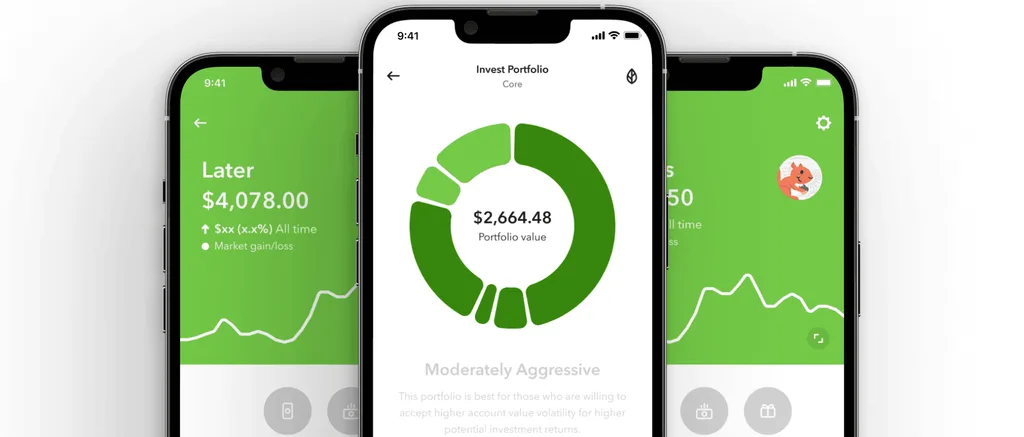
2. Betterment — Best for Guidance and Goal Planning
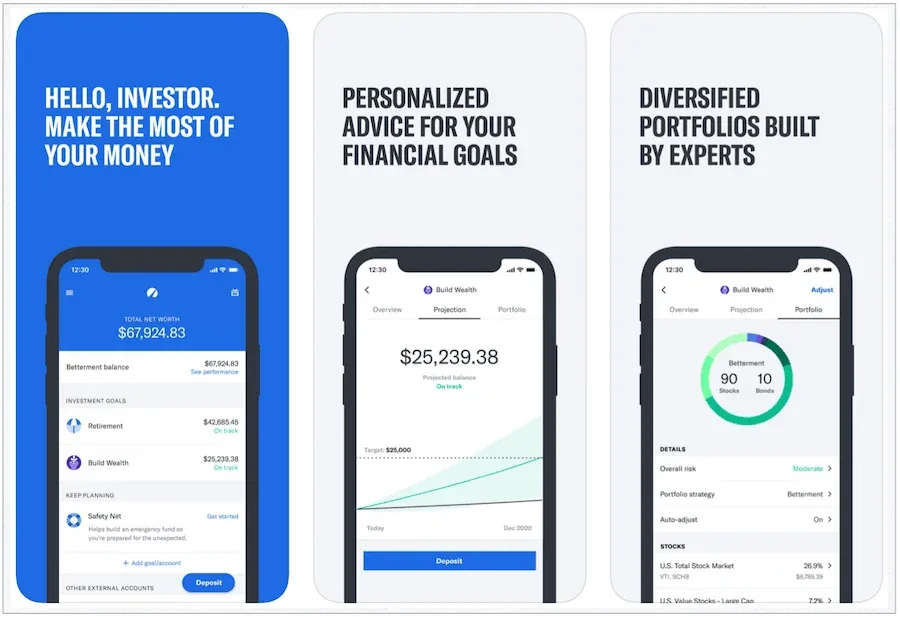
Betterment is the original robo-advisor and still one of the best for beginners who want to feel guided. It builds a diversified ETF portfolio, rebalances automatically, and offers tax-loss harvesting on taxable accounts. Its Digital plan costs $5 per month — unless you keep at least $24,000 invested or set up recurring deposits of $200 or more per month, in which case you pay 0.25% per year instead. The Premium plan costs 0.65% per year, requires a $100,000 balance, and adds unlimited access to human certified financial planners. You can start with $10.
Where Betterment shines is goal planning: it tells you whether you’re on track for retirement, a house, or a vacation, and adjusts your portfolio accordingly. Its interface is friendlier than Fidelity’s for first-timers. Just be aware that on a very small balance, the $5 monthly fee can equal a high effective percentage — so either deposit $200/month or grow past $24,000 to switch to the percentage rate.
Key details:
- Fee: $5/mo, or 0.25%/yr with $24k+ balance or $200+/mo deposits; Premium 0.65% at $100k.
- Minimum: $10.
- AI: Goal-based portfolio allocation, automatic rebalancing, tax-loss harvesting.
- Pros: Best-in-class guidance, human CFP upgrade, strong mobile app.
- Cons: $5/mo fee is steep on tiny balances; Premium is pricey at 0.65%.
3. Wealthfront — Best for Automation and Tax Optimization
Wealthfront is the most hands-off option. It builds your portfolio, rebalances daily, and runs daily tax-loss harvesting on taxable accounts — a feature that can save you more in taxes than the app costs. It charges 0.25% per year with a $500 minimum. Its “Self-Driving Money” feature can even automate your cash flow: paycheck comes in, bills get paid, surplus moves to the right account automatically.
The $500 minimum is higher than Fidelity or Betterment, which is why it ranks third for true beginners. But once you have $500 saved, Wealthfront is arguably the most powerful automated option. It also offers a high-yield cash account and lines of credit. It does not offer human advisors — if you want to talk to a person, go with Betterment Premium.
Key details:
- Fee: 0.25%/yr.
- Minimum: $500.
- AI: Daily tax-loss harvesting, automated rebalancing, Self-Driving Money cash flow.
- Pros: Best tax optimization, strongest automation, high-yield cash included.
- Cons: $500 minimum, no human advisors, fee applies from dollar one.
4. Acorns — Best for Building the Investing Habit
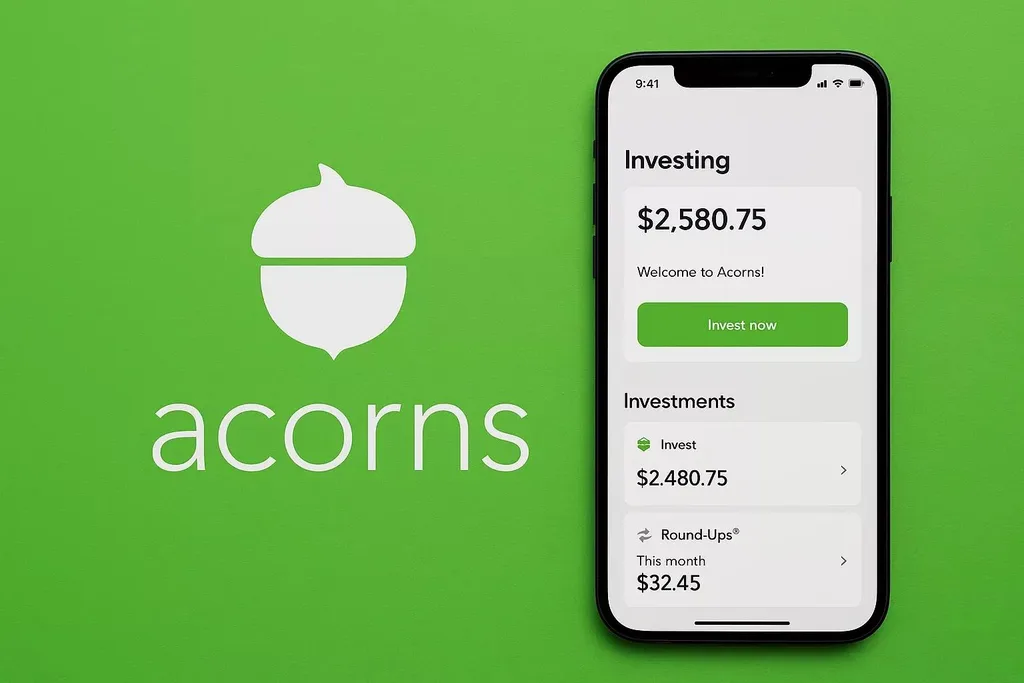
Acorns invented “round-up” investing: every time you spend, it rounds the purchase up to the nearest dollar and invests the spare change into a diversified ETF portfolio. It is the single most psychologically effective way to turn a non-investor into an investor, because you barely notice the money leaving. You can open with $0 and start investing with $5.
The catch is pricing. Acorns raised its fees in August 2026: new subscribers now pay $4/month (Bronze), $8/month (Silver), or $12/month (Gold). On a small balance, that flat fee can equal a high effective percentage — $48/year on a $500 account is nearly 10%. So Acorns is brilliant for building the habit, but once your balance grows past a few thousand dollars, a percentage-fee robo-advisor becomes cheaper. Acorns has historically offered student discounts — check for current promotions before signing up.
Key details:
- Fee: $4–$12/month flat subscription.
- Minimum: $5 to invest.
- AI: Round-Ups auto-invest, pre-built ETF portfolios, recurring deposits.
- Pros: Painless habit-building, no stock-picking decisions, retirement account included.
- Cons: Flat fee is expensive on small balances, limited customization, price increased in 2026.
5. SoFi Invest — Best Free All-in-One App
SoFi Invest is the best free option for beginners who want both hands-off and hands-on investing in one app. Its Active Invest account charges $0 commission on stocks and ETFs, offers fractional shares, and pays a 1% match on IRA contributions (2% if you join SoFi Plus for $10/month). It also offers roughly 29 cryptocurrencies for trading, relaunched after a pause. Its Automated Investing robo-advisor costs 0.25% per year with a $50 minimum. SoFi also bundles banking, loans, and credit cards, so you can see your whole financial life in one place.
SoFi’s robo-advisor, once free, introduced a 0.25% fee in late 2024. Still, for a beginner who wants zero-commission stock trading plus an automated option, SoFi is hard to beat — and all members get a complimentary 30-minute session with a financial planner.
Key details:
- Fee: $0 stock/ETF trades; robo-advisor 0.25%/yr; SoFi Plus $10/mo.
- Minimum: $1 for fractional shares; $50 for robo-advisor.
- AI: Automated robo portfolios; goal tracking; IRA match.
- Pros: Free trading, all-in-one finance, IRA match, crypto available, free planner session.
- Cons: Robo now charges 0.25%, weaker research tools than Robinhood.
6. Robinhood — Best for Self-Directed Beginners (With a Caution)
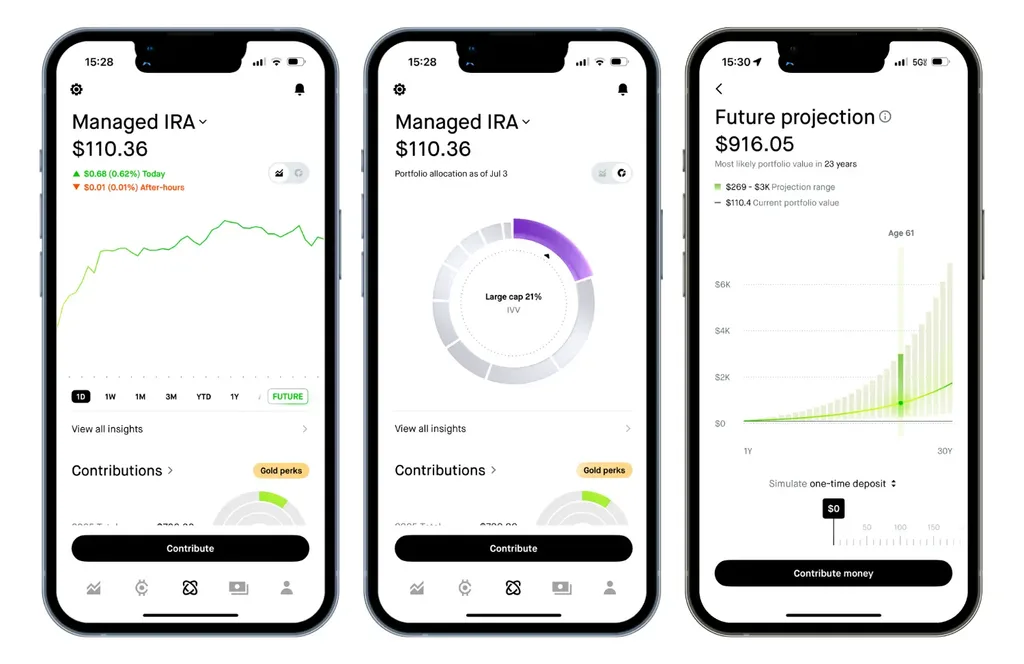
Robinhood made zero-commission trading mainstream, and it remains the most popular app for beginners who want to pick their own stocks and ETFs. It charges $0 commissions, has no account minimum, offers fractional shares from $1, and now includes Robinhood Cortex — an AI tool (for Gold members) that generates plain-English “Digests” explaining why a stock or your portfolio moved, plus an AI market scanner. In May 2026, Robinhood also opened its platform to third-party AI agents that can trade on your behalf with guardrails like spending limits and a kill switch. Robinhood Gold ($5/month) adds a 3% IRA match, margin investing, and bigger instant deposits. Its robo-advisor, Robinhood Strategies, charges 0.25% (waived above $100,000 for Gold members) with a $50 minimum.
The honest warning: Robinhood’s gamified interface encourages frequent trading, and study after study shows that frequent trading reduces returns for beginners. Use Robinhood if you want to learn by doing — but set a rule, like “no more than 10% of my portfolio in individual stocks,” and put the rest in index funds. The AI Digests are great for learning, but they are not investment advice, and letting an AI agent trade for you is an experiment, not a strategy.
Key details:
- Fee: $0 trades; Gold $5/mo; Strategies robo 0.25%/yr.
- Minimum: $0; $1 fractional shares; $50 for Strategies.
- AI: Cortex AI Digests, AI market scanner, agentic trading (beta, with guardrails).
- Pros: Free trading, easy interface, crypto available, IRA match with Gold, most advanced AI tools.
- Cons: Gamified design can cause overtrading, past outages, weaker retirement planning.
7. Magnifi — Best Pure AI Research Assistant
Magnifi is the closest thing to “ChatGPT for investing” run by a licensed platform. You ask plain-English questions — “compare VTI and VOO” or “build a beginner portfolio for a 25-year-old” — and its AI pulls real, sourced data and explains the reasoning. The free tier gives you 10 queries a day; the Plus tier (about $13/month) unlocks unlimited queries and full portfolio analysis. If you want it to manage money, Magnifi Personal charges about 0.50% of assets annually.
Magnifi will not hold your hand the way a robo-advisor does — it is a research layer, not a portfolio manager. But for a beginner who wants to learn by asking questions before committing money, it is the best AI-first tool on the market. If you use it, remember that good prompt engineering makes the answers sharper: specify your age, risk tolerance, and goal in every question.
Key details:
- Fee: Free (10 queries/day); Plus ~$13/mo; managed ~0.50% AUM.
- Minimum: $1.
- AI: Conversational natural-language investing research; portfolio health scoring.
- Pros: Best way to learn by asking, connects major brokerages, cheap premium.
- Cons: Not a full robo-advisor, analysis can be shallow, younger brand.
Honorable Mentions
- M1 Finance — free custom portfolio “Pies” with automatic rebalancing; $100 minimum; great once you know what you want.
- Q.ai — AI-selected “Investment Kits” from $100; free basic tier, premium ~$10/month.
- Schwab Intelligent Portfolios — $0 advisory fee but $5,000 minimum and a cash drag that reduces returns.
- Vanguard Digital Advisor — ~0.20% fee but $3,000 minimum; best for committed index-fund investors.
- Composer — no-code AI strategy building; more intermediate, $50 minimum.
What Returns Should You Actually Expect?
Set your expectations correctly and you won’t panic when the market dips. The S&P 500 has returned about 7% per year on average after inflation over the long run. That means:
- A one-time $1,000 investment grows to roughly $2,000 in 10 years, $4,000 in 20 years.
- $100 invested every month for 30 years at 7% becomes about $120,000 — and you only put in $36,000.
- Some years you will lose money. In a bad year, the market can drop 20–30%. That is normal. The worst thing you can do is sell during a dip.
No AI app can promise you above-market returns. The apps’ real value is keeping you invested through the dips and keeping your costs low — both of which beat the average investor’s actual results.
How to Open Your First Account in 5 Steps
- Pick one app. Use the table above; for most beginners, Fidelity Go or Betterment.
- Sign up with your SSN and bank info. It takes about 10 minutes.
- Answer the risk questionnaire honestly. If you’ll panic at a 20% drop, choose a more conservative portfolio.
- Set up an automatic monthly deposit. Even $10–$25. Automation beats willpower.
- Leave it alone. Check your balance no more than once a month. Set a calendar reminder if you have to.
Stay Safe: What to Watch Out For
Legitimate investing apps are regulated. Check three things before depositing:
- SIPC protection. The broker should be a SIPC member, which protects your securities up to $500,000 if the broker fails. FINRA’s free investing basics hub explains how brokerage accounts work.
- Fiduciary duty. Robo-advisors should be registered investment advisers, legally required to act in your best interest.
- No guaranteed returns. Any app or influencer promising “guaranteed 20% monthly returns” is running a scam. The market does not work that way.
Frequently Asked Questions
What is the best AI investing app for beginners in 2026?
For most beginners, Fidelity Go is the best pick because it charges no advisory fee under $25,000 and lets you start with $10. Betterment is the best if you want more guidance and goal planning.
Are AI investing apps safe?
Yes, when they are regulated broker-dealers or registered investment advisers with SIPC protection. Verify the firm on Investor.gov before depositing. Avoid any app promising guaranteed high returns.
How much money do I need to start?
Most apps let you start with $5–$10 thanks to fractional shares. Wealthfront requires $500 and Schwab requires $5,000, but Fidelity Go, Betterment, Acorns, SoFi, and Robinhood all start under $50.
Do AI investing apps actually beat the market?
No — and they don’t try to. They match the market at very low cost while removing human mistakes like panic-selling. Over time, that beats most active investors.
What fees should I watch for?
Watch for annual advisory fees (0.25–0.35% is standard), flat monthly subscriptions (expensive on small balances), expense ratios of the funds you own (aim for under 0.10%), and trading commissions (should be $0).
Can I lose money with an AI investing app?
Yes. The market goes down in bad years, and no app can prevent that. The apps manage the process and reduce risk through diversification; they cannot eliminate market risk. Keep money you’ll need within 3–5 years out of stocks.
Should I use a robo-advisor or pick stocks myself?
For 90% of beginners, a robo-advisor or low-cost index fund beats picking individual stocks. If you want to pick stocks, limit it to 5–10% of your portfolio and learn as you go.
Is Robinhood good for beginners?
Robinhood is good for beginners who want free, easy trading — but its gamified design encourages overtrading, which hurts returns. Use it with discipline, or pair it with a robo-advisor for the bulk of your money. Its Cortex AI Digests are genuinely useful for learning.
Final Verdict
You don’t need the perfect app — you need one you’ll actually use. Start with Fidelity Go if fees matter most, Betterment if you want guidance, or Acorns if you struggle to save. Set up an automatic monthly investment of whatever you can afford, even $10, and check your balance no more than once a month. The greatest advantage a beginner has is time — let compounding do the work, and let the AI handle the boring parts.